Trailer Landing Gear Failure: Diagnosing Crank & Pad Wear
October 29, 2026 · PartsNow Guides
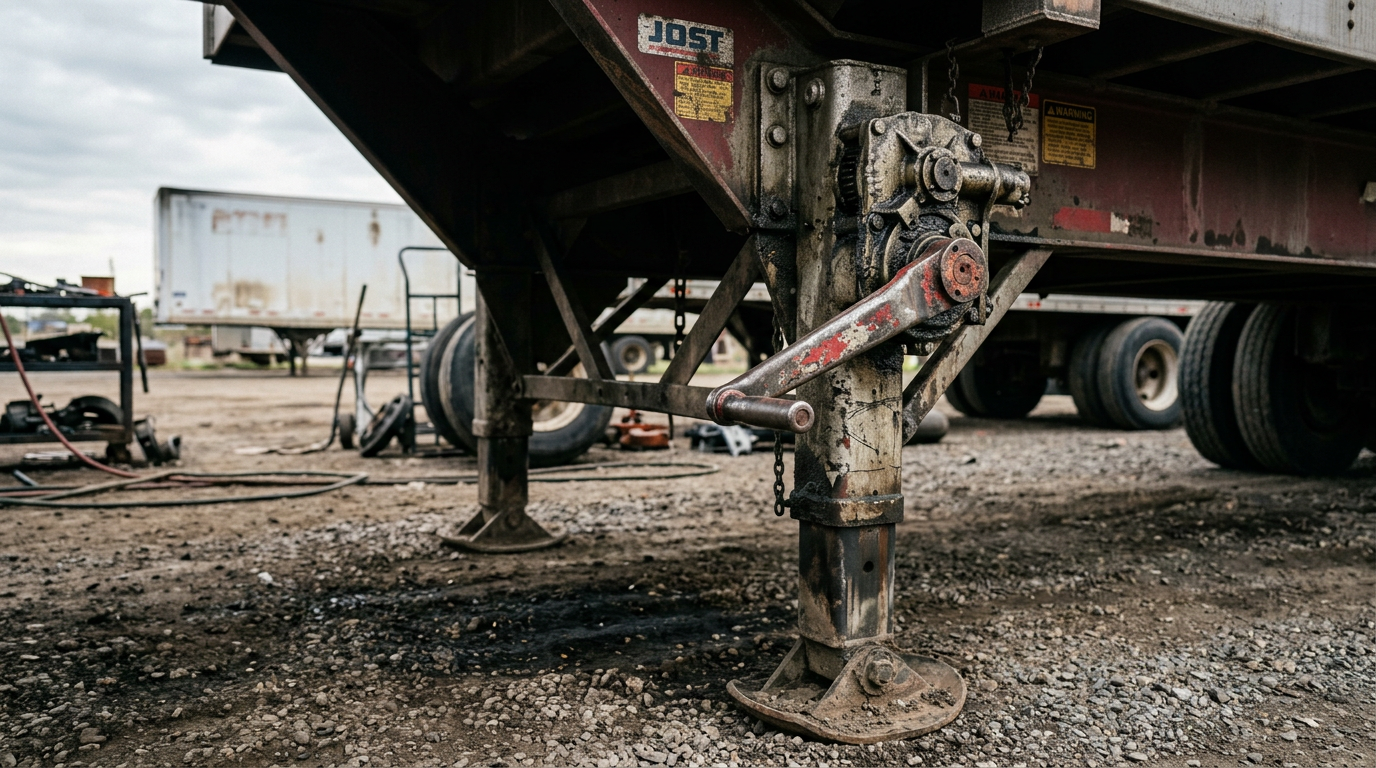
You drop the trailer, pull out from under it, and that crank handle feels like it's turning concrete. Or worse — the legs won't retract all the way and you're rolling down the highway with landing gear hanging half-extended, waiting to catch a curb or a railroad crossing. Landing gear failure doesn't usually happen all at once. It tells on itself for weeks before it strands a load or drops a trailer in a customer's yard.
Most of these failures trace back to three things: a worn-out gearbox, a bent or binding leg assembly, or a chewed-up foot pad that's lost its footing on soft ground. None of it's complicated once you know what to check, and catching it early is a lot cheaper than a cargo claim or a DOT out-of-service tag for defective landing gear.
This guide walks through how to spot the warning signs, what's actually wearing out inside that gearbox, and a checklist you can run in five minutes at a pre-trip or PM inspection.
Why Landing Gear Fails: The Three Usual Suspects
Gearbox wear is the number one culprit. The internal gears strip or the shear pin gives out from years of cranking without grease, or from someone forcing the handle when the legs were already binding on something else. Once the gearbox teeth round off, you get that familiar "crank spins but legs don't move" feeling.
Leg binding happens when the inner leg (the part that telescopes) gets bent from a hard drop, side-loaded during a bad coupling, or just rusted solid inside the outer sleeve from lack of lube. A bent leg will crank hard in one direction and bind up tight before it's fully extended or retracted.
Foot pad damage is the quiet killer. A cracked, bent, or undersized pad sinks into soft asphalt or gravel under load, which torques the whole leg sideways and transfers stress right back into the gearbox and crank handle. A lot of "gearbox failures" start as a pad that gave up a year earlier.
Warning Signs You Can Catch Before It Fails
Don't wait for the legs to freeze solid. Watch for these early signs during pre-trip or at the yard:
- Hard cranking that's gotten progressively worse over a few weeks, not just cold-weather stiffness
- Grinding or clicking from the gearbox housing when you turn the handle
- Uneven leg extension — one side touches down before the other
- Visible lean in the trailer when the legs are fully down and the brakes are set
- Rust streaks or bare metal showing through where grease should be holding
- Bent or cracked foot pads, especially on the inside edge where ground pressure concentrates
- Play or wobble in the leg where it bolts to the trailer frame
Any one of these on its own is worth a closer look. Two or more together means don't trust that landing gear with a loaded trailer until it's inspected properly.
Gearbox Diagnosis: What's Actually Wearing Out
Pop the gearbox cover or access panel if your unit has one, and look for grease that's turned black, gritty, or dried out completely — that's the first sign the box has been running dry. Dry gears wear fast and start shedding metal shavings, which you'll feel as grinding before you ever see it.
Check the shear pin if your gearbox uses one — it's designed to snap before the gears do when someone over-cranks against a bind. A sheared pin with otherwise good gears is a cheap fix. A stripped internal gear means the whole gearbox assembly needs replacing — per OEM spec for your landing gear manufacturer, since gearboxes aren't universal across brands.
Spin the crank handle disconnected from the leg shaft if possible. If it's still rough or notchy with no load on it, the problem's inside the box, not downstream in the leg. If it turns smooth standalone but binds once connected, you're looking at a leg or shaft alignment problem instead.
Leg and Foot Pad Inspection
With the trailer safely supported — never with your body under a leg that's under load — walk both legs top to bottom:
- Check the inner leg tube for visible bends, dents, or rust pitting along its length
- Confirm both legs extend and retract at the same rate when cranked together; a mismatch points to a bent leg or worn gear teeth on one side
- Inspect the foot pad for cracks, deformation, or a pad that's been welded/patched before
- Make sure the pad still swivels freely — a seized pivot pin transfers load wrong and bends pads fast
- Check mounting bolts and brackets where the leg attaches to the trailer frame for looseness or elongated bolt holes
A bent inner leg almost never gets better — it's a replacement item, not a straighten-and-reuse job. Trying to force a bent leg back into service is how you end up with a trailer drop at a customer dock.
Lubrication: The Cheapest Insurance You've Got
Most landing gear failures are preventable with a grease gun and five minutes a month. Grease the gearbox zerk fitting and the leg tube's inner/outer sleeve contact points per OEM spec interval — don't stretch it out just because the handle still turns okay.
Use a grease rated for the temperature range you actually run in; a grease that gums up in winter cold will make the legs feel like they're seizing even when the gears are fine. Wipe off old, dirty grease buildup before adding new — packed-in grit acts like sandpaper on the gear teeth and leg tubes every time you crank.
If a trailer's been sitting unused for months, don't just crank it cold. Work the handle gently a few turns at a time, adding grease as you go, to loosen rust before it tears up the gearbox internals on a hard yank.
Quick answers
Why is my trailer landing gear hard to crank?
Usually it's dry or contaminated grease in the gearbox, a bent inner leg binding in the outer sleeve, or worn/stripped gear teeth inside the gearbox. Grease it first and see if that frees it up before assuming it's a gearbox replacement.
Can I straighten a bent landing gear leg instead of replacing it?
No — a bent inner leg has already weakened at the bend point and will fail again under load, often without warning. Replace the leg assembly per OEM spec rather than straighten and reuse it.
How often should I grease trailer landing gear?
Follow the OEM-recommended interval for your specific gearbox and leg assembly, but as a baseline, check and grease at every PM service and anytime you notice harder-than-normal cranking.
What causes a trailer to lean when the landing gear is down?
A lean usually means one leg is extending less than the other, which points to uneven foot pad sinking into soft ground, a bent leg, or mismatched gear wear between the two sides. Check both legs side by side with the trailer unhooked but still supported.
Is a cracked landing gear foot pad a DOT violation?
A damaged or non-functional foot pad that compromises the landing gear's ability to support the trailer can be cited during inspection, since landing gear is part of the trailer's required support system. Replace cracked or bent pads before your next inspection, and have a certified tech confirm the leg and gearbox are sound too.
Parts for this job
Real products from the PartsNow catalog. Confirm fitment with Mike before ordering.

3151503
3151503 - OIL BATH SEAL WEAR RING
$40.13

3030HNTRX
3030HNTRX - 3030 SPEC LONG SHAFT HNTRX BRAKE CHAMBER
$84.04

OTR10143
OTR10143 - AUTO SLACK ADJUSTER, 11/2-10DRIVE 5.5,6.5
$150.00

5-808330
5-808330 - BRAKE KIT FOR 4709DEN SHOES
$14.38

370036A
370036A - OIL BATH SEAL
$45.94

348-4195
348-4195 - HUB CAP (SENTINAL LARGE DIAM)
$51.88

482414R
482414R - MUD FLAPS 24 X 14 PLAIN
$15.00

91-18
91-18 - WIPER BLADE
$4.97
Still not sure what's wrong?
Mike — the free AI truck consultant — will walk through your exact symptoms and point you to the right part. No account, English or Spanish, 24/7.
