Fifth Wheel & Kingpin Wear: Coupling Maintenance Guide
September 17, 2026 · PartsNow Guides
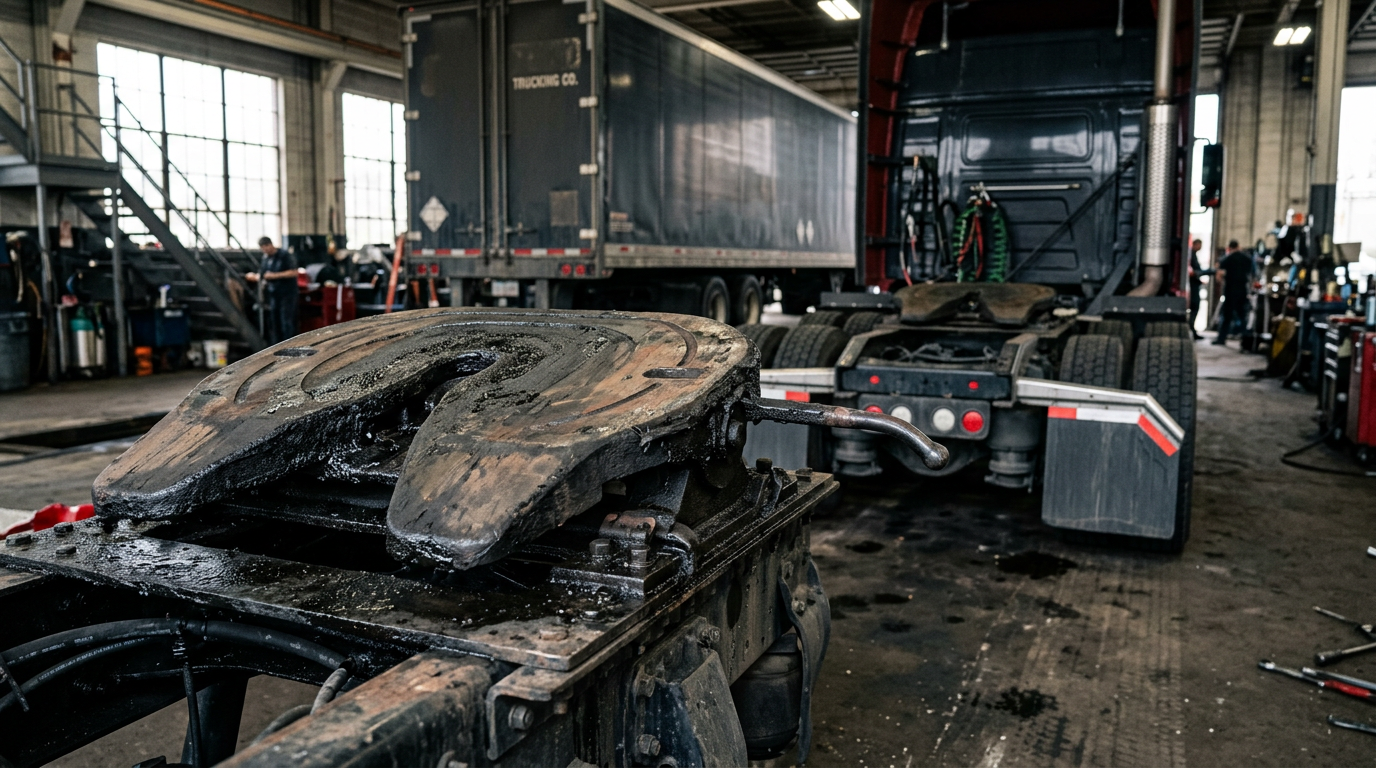
If you've ever felt that unsettling clunk on a hard turn, or watched a DOT officer walk straight to your fifth wheel with a wear gauge in hand, you know this coupling is not the place to get lazy. The fifth wheel and kingpin are the only thing physically holding your tractor to your trailer at 80,000 pounds — and they take a beating every single time you back under, pull a pin, or hit a rough yard.
Most coupling failures don't happen suddenly. They creep in over thousands of hitch cycles as the kingpin, the fifth wheel jaws, and the top plate slowly wear past spec. By the time you notice slack in the coupling or a trailer that won't lock solid, you're usually already past the point where a grease gun fixes it.
This guide walks through what to check, how often to lube it, and how to tell when you're looking at a rebuild versus a full replacement — before it becomes a roadside violation or worse.
Why Coupling Wear Matters More Than You Think
The fifth wheel and kingpin work together as a locking system, not two separate parts. As the kingpin wears thin and the locking jaws in the fifth wheel wear open, the coupling develops play — sometimes called "walking" or "hitch slop." That play multiplies stress on both components every time you brake, turn, or hit a pothole, so wear accelerates the more it's ignored.
Beyond the mechanical risk, this is a top DOT inspection point. Officers check kingpin diameter and fifth wheel jaw clearance with a go/no-go gauge, and a failed reading is an out-of-service violation — full stop. A trailer that separates from the tractor, even partially, is a catastrophic failure with zero margin for error.
Bottom line: coupling wear isn't cosmetic. It's a safety-critical wear item that needs the same discipline as brakes or steering, and any adjustment or repair should be signed off by a certified tech.
Inspecting the Fifth Wheel Plate
Start with the top plate — the flat surface the trailer's upper coupler rides on. Look for:
- Grooves or gouges deeper than a few thousandths (these accelerate friction and wear on the upper coupler)
- Uneven wear patterns suggesting the plate isn't sitting level or the trailer is riding low
- Cracks around the mounting bolts or bracket welds
- Excessive play when you rock the plate side to side by hand
Check the locking jaws next. With the trailer pinned, try to move it front-to-back and side-to-side. Any noticeable movement means the jaws have opened up beyond spec and aren't gripping the kingpin tight. Also check that the release handle moves freely and the safety latch actually engages — a sticky handle is often the first sign of a jaw or spring problem.
Use an OEM-spec wear gauge on the jaws themselves, not just a visual check. Visual inspection alone misses gradual wear that a gauge catches immediately.
Checking Kingpin Play and Diameter
The kingpin takes the brunt of the wear because it's the pivot point for every turn the rig makes. A worn kingpin develops an hourglass shape — thinner in the middle where the jaws grip it, still full diameter at the base.
Measure kingpin diameter with a proper gauge at multiple points around the shaft, not just one spot. Per OEM spec, there's a minimum diameter the kingpin has to stay above; below that, it fails inspection regardless of how it looks by eye.
Also inspect the kingpin's mounting to the upper coupler plate on the trailer. Loose mounting bolts or elongated bolt holes mean the kingpin is shifting under load even if the pin itself measures fine. That shift accelerates jaw wear on the tractor side and can mask itself as a fifth wheel problem when the real issue is on the trailer.
This is wheel-end-adjacent, safety-critical work — any kingpin replacement or remounting needs a certified tech's sign-off before the trailer goes back in service.
Lubrication Schedule That Actually Prevents Wear
Dry coupling components wear fast, and a lot of owner-operators under-grease this because it's not an obvious daily check like tires or lights.
- Grease the top plate before every hitch if you're running gravel, construction sites, or dirty yards — daily for high-cycle operations
- For standard OTR use, grease the plate every hitch cycle or at minimum once a week
- Use OEM-recommended grease type — fifth wheel grease is formulated to stay put under pressure and heat, unlike standard chassis grease
- Grease the locking mechanism pivot points and release handle linkage on the same schedule to keep the jaws moving freely
- Wipe old, dirty grease off before reapplying — grit trapped in old grease acts like sandpaper on the plate
Skipping lube doesn't just cause noise and hard hitching. It's the single biggest accelerant of plate and jaw wear you can control with five minutes of work.
Replace vs. Rebuild: Making the Call
A rebuild kit on the fifth wheel — new jaws, springs, and locking hardware — makes sense when the top plate itself is still within spec and the mounting brackets are solid. If jaw wear is the only issue and the plate surface is clean, a rebuild gets you back in spec for a fraction of a full unit swap.
Full fifth wheel replacement is the right call when the top plate has deep gouging, cracked welds, or has been reground past OEM tolerance already. A tired plate on a fresh jaw kit just wears the new parts out faster.
For the kingpin, there's rarely a rebuild option — it's a wear item that gets replaced outright once it's under diameter spec or the mounting shows damage. Don't try to weld-build a worn kingpin back up; that's not a safe repair and it won't pass inspection or hold up under load.
When in doubt, get a certified tech to gauge everything before you decide — guessing on this component isn't worth the risk.
Quick answers
How do I know if my kingpin is worn out?
Use a proper kingpin wear gauge to check diameter at several points — if it reads below OEM minimum spec anywhere, it's worn out and needs replacement. Visible hourglassing or shininess in the middle section is also a red flag worth gauging immediately.
Why does my fifth wheel clunk when I turn?
A clunk on turns usually means the locking jaws have worn open enough to let the kingpin move inside them, or the top plate has excessive play in its mounting. Get it gauged before your next trip — this is coupling slop, not just a noise issue.
How often should I grease my fifth wheel?
For standard OTR use, grease the top plate at minimum once a week or every hitch cycle; if you're running dirty yards or gravel sites, grease before every hitch. Under-lubing is one of the fastest ways to accelerate plate and jaw wear.
Can a worn fifth wheel fail a DOT inspection?
Yes — officers check kingpin diameter and fifth wheel jaw clearance with a go/no-go gauge, and a failed reading is an automatic out-of-service violation. This is one of the most commonly cited coupling issues in roadside inspections.
Should I rebuild or replace my fifth wheel?
If the top plate is still within spec and only the jaws and springs are worn, a rebuild kit is usually the cost-effective fix. If the plate itself is gouged, cracked, or already reground past tolerance, full replacement is the safer call.
Parts for this job
Real products from the PartsNow catalog. Confirm fitment with Mike before ordering.

3151503
3151503 - OIL BATH SEAL WEAR RING
$40.13

3030HNTRX
3030HNTRX - 3030 SPEC LONG SHAFT HNTRX BRAKE CHAMBER
$84.04

OTR10143
OTR10143 - AUTO SLACK ADJUSTER, 11/2-10DRIVE 5.5,6.5
$150.00

5-808330
5-808330 - BRAKE KIT FOR 4709DEN SHOES
$14.38

370036A
370036A - OIL BATH SEAL
$45.94

348-4195
348-4195 - HUB CAP (SENTINAL LARGE DIAM)
$51.88

482414R
482414R - MUD FLAPS 24 X 14 PLAIN
$15.00

91-18
91-18 - WIPER BLADE
$4.97
Still not sure what's wrong?
Mike — the free AI truck consultant — will walk through your exact symptoms and point you to the right part. No account, English or Spanish, 24/7.
