DPF Regen Failures: Diagnosing Soot Buildup & Derates
October 27, 2026 · PartsNow Guides
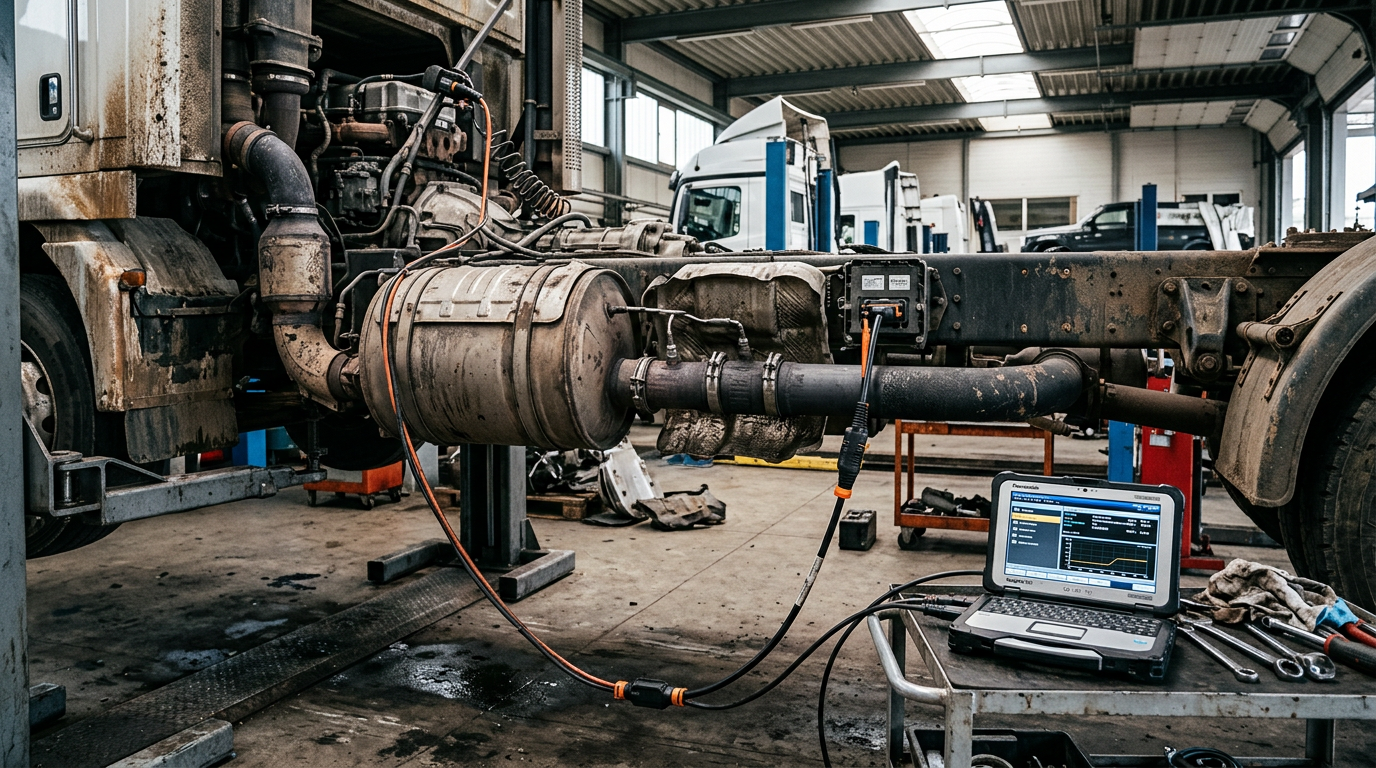
If you've got a truck sitting in the yard flashing a DPF lamp and crawling along in derate, you already know the drill — dispatch is calling, the load's late, and you're staring at a dash full of warning icons trying to figure out if this is a five-minute parked regen or a filter coming off the truck. Repeat regen failures are one of the most common reasons trucks end up down, and most of the time the root cause isn't the DPF itself — it's something upstream feeding it bad information or bad conditions.
This guide walks through how to read what the truck is actually telling you, the usual suspects behind failed or incomplete regens, and how to decide between letting the system do its thing, forcing a regen, or pulling the filter for service. We'll anchor the examples to the International HV Series since it's a common vocational and regional-haul platform where short-cycle duty patterns make this problem show up a lot — but the diagnostic logic applies across most modern diesel aftertreatment systems.
Reading the Dash: Lamps, Soot Codes, and Derate Stages
Most trucks give you a staged warning before they ever cut power. First you'll see the DPF lamp or HEST (high exhaust system temperature) lamp, which just means the system wants to regen or is actively regenerating. Ignore that long enough and you'll get a flashing lamp plus a check engine light — that's your cue the soot load has crossed a threshold where a normal drive-cycle regen isn't cutting it anymore.
Stage 1 derate usually limits top speed or throttle response. Stage 2 is the serious one — power drops hard, sometimes down to idle-only, forcing you to pull over. Pull codes with your scan tool before doing anything else. You're looking for soot load percentage (per OEM spec thresholds — don't guess at the number, read it off the tool), differential pressure across the DPF, and any active sensor fault codes. A truck showing high soot load but no sensor faults is a different animal than one throwing a delta pressure sensor or NOx sensor code alongside it.
What's Really Happening Inside the Filter
The DPF traps soot, and the system periodically burns it off by raising exhaust temp — either passively during normal highway driving or actively through a commanded regen where extra fuel is injected to spike temps. A completed regen drops the soot load percentage back down near zero. An incomplete one means the burn started but didn't finish, usually because exhaust temps couldn't be sustained long enough.
Over time, if regens keep failing or getting interrupted, you build up ash on top of the soot — ash doesn't burn off, it just sits there taking up capacity. That's the difference between a soot problem (regen will fix it) and an ash problem (only a filter cleaning or replacement fixes it). If you're seeing repeat regen failures on a filter with high mileage or hours, don't keep forcing regens hoping it'll clear — check ash loading history or pull the filter and have it measured.
The Usual Suspects Behind Repeat Regen Failures
Three causes account for most of the repeat failures we see in the shop:
- Short-haul duty cycles — lots of idle time, stop-and-go, never getting sustained highway RPM. The engine never generates enough exhaust heat for a passive regen, so the system keeps stacking active regen requests that get interrupted by the driver stopping or shutting down. Common on local delivery HVs running the same route all day.
- Bad sensors — a drifting differential pressure sensor or exhaust temp sensor feeding the ECM bad data makes the system think soot load is higher or lower than reality, triggering unnecessary regens or skipping needed ones.
- Exhaust leaks — a leak upstream of the DPF (manifold, turbo outlet, or a loose DOC connection) bleeds off exhaust heat before it reaches the filter, so even a commanded regen can't hit target temps. Listen for exhaust tick or hissing under load, and check for soot staining at joints.
Fix the root cause first — forcing more regens on a truck with a leak or bad sensor just wastes fuel and time.
Parked Regen, Forced Regen, or Filter Service — How to Decide
- Parked regen is your first move for moderate soot load with no active fault codes. Park it, follow the dash prompts, let it run its cycle — usually 20-45 minutes depending on soot level.
- Forced regen (via scan tool, shop-initiated) is for trucks that won't complete a parked regen on their own, or where soot load is high enough the system won't let you drive it to a spot to park regen. This needs a diagnostic tool connected and someone watching exhaust temps.
- Filter removal and cleaning/replacement is the call when: forced regen won't complete, differential pressure stays high even after a completed regen, you've got high ash loading per the filter's service history, or you're seeing repeat failures with no sensor or leak fault found. Don't keep throwing regens at a filter that's physically past its cleaning interval — per OEM spec service intervals, that just risks substrate damage.
If you've forced three or more regens on the same truck in a short window and it's still derating, stop and diagnose — you're chasing a symptom, not the cause.
International HV Series Notes
The HV Series shows up a lot in vocational, refuse, and regional distribution work — exactly the kind of stop-and-go duty cycle that stacks up passive regen opportunities and leans hard on active/forced regens instead. If you're running HVs on short routes with lots of idle, expect more frequent dash prompts for regen and budget time for it rather than fighting it.
Check the DPF differential pressure sensor and its hose routing first on repeat failures — vibration from vocational use (refuse bodies, dump applications) can work these lines loose or crack them over time, feeding bad pressure readings to the ECM. Also inspect the exhaust clamps and flex sections between the turbo and DOC — vocational chassis flex more under load and leaks develop at these joints more often than on a straight highway tractor. Always verify fault codes and sensor data against International's published diagnostic procedures before replacing parts.
Quick answers
Why does my truck keep derating after I do a regen?
If the regen completes but you derate again soon after, suspect a sensor feeding bad data (differential pressure or exhaust temp) or an exhaust leak robbing heat from the DPF. Pull codes and check for leaks before forcing another regen — repeating the same fix won't help if the root cause is upstream.
Can I do a forced regen myself?
Yes, with a compatible scan tool and the truck in a safe, ventilated spot since exhaust temps run very high during the process. Follow the tool's prompts and don't walk away — if temps or soot percentage aren't dropping as expected, stop and diagnose rather than keep forcing it.
How do I know if my DPF needs cleaning versus a new filter?
A cleaning handles ash buildup if the substrate is still structurally sound and within its OEM-specified cleaning interval; a shop can measure ash loading and back-pressure to confirm. If the filter's been through multiple cleanings already or shows cracking/melting, replacement is the safer call.
What causes a DPF to not regen at all?
Usually it's not enough sustained exhaust heat — short-haul duty cycles, a failing exhaust temp sensor, or an exhaust leak are the top three causes. Less common but possible is a fuel dosing/injector issue on systems that use fuel-assisted regen.
Is it safe to keep driving with the DPF lamp on?
A steady DPF lamp just means a regen is needed or running — fine to keep driving per normal operation. A flashing lamp or any derate warning means stop and address it soon, since ignoring it leads to a hard power cut that can leave you stranded.
Parts for this job
Real products from the PartsNow catalog. Confirm fitment with Mike before ordering.


Still not sure what's wrong?
Mike — the free AI truck consultant — will walk through your exact symptoms and point you to the right part. No account, English or Spanish, 24/7.
Related truck: International HV Series— specs & parts
