Trailer Axle Misalignment: Diagnosing Dog-Tracking & Tire Wear
November 26, 2026 · PartsNow Guides
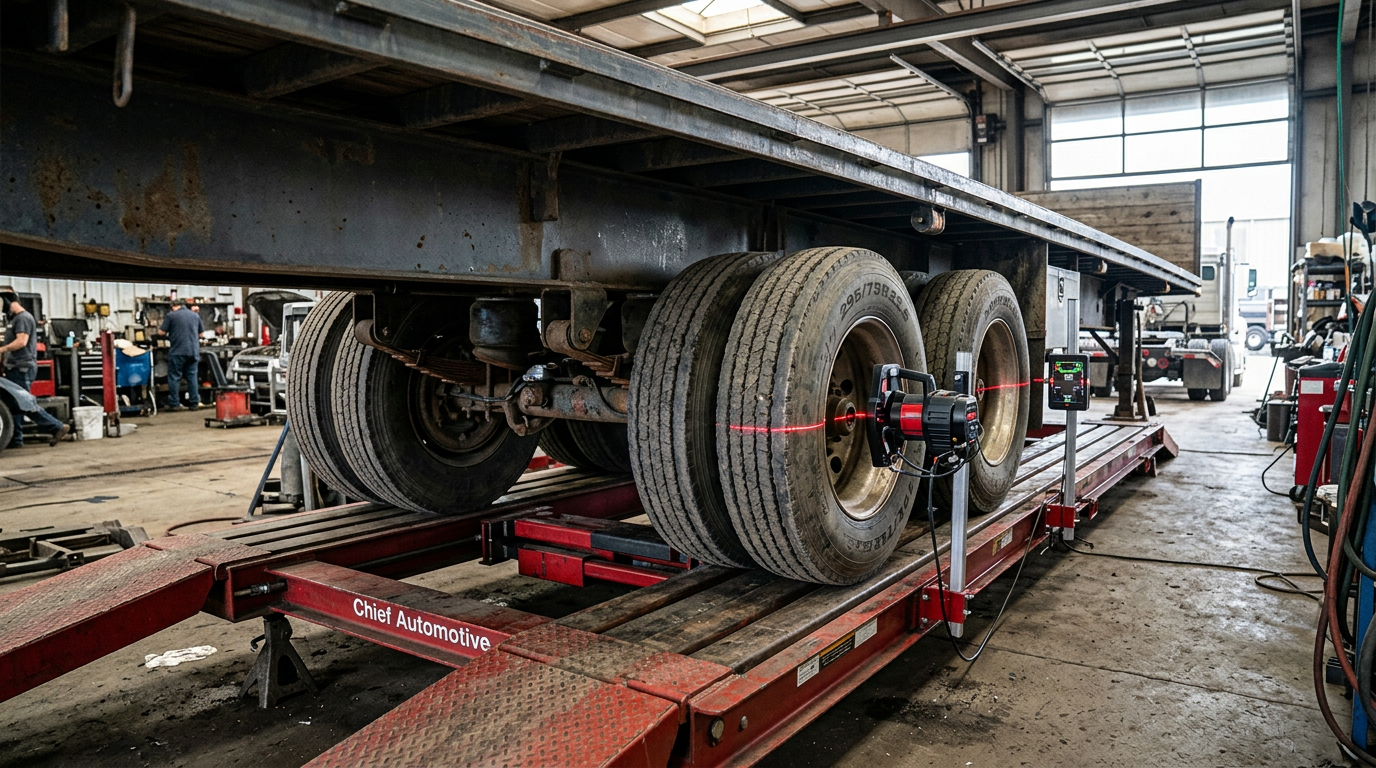
You're following a trailer down the highway and it's running sideways — crabbing along at an angle instead of tracking straight behind the tractor. That's dog-tracking, and it's your trailer telling you something's bent, worn, or knocked out of spec. Ignore it long enough and you'll feed a brand new set of tires to the problem in under 20,000 miles.
Most drivers blame the tires first. Feathered edges, cupping, one-sided wear — they figure it's a bad batch of rubber or an alignment at the tractor. But if the wear pattern is only on the trailer axles, the tractor's clean, and the trailer looks like it's dogging down the road, you're chasing a trailer alignment problem, not a tire problem.
This guide walks through how to spot it, what causes it, what you can check yourself, and when the job needs to go to a frame shop instead of staying in your bay.
Spotting Dog-Tracking on the Road and in the Yard
Dog-tracking is when the trailer runs at an angle to the direction of travel — rear end offset from the front, like the whole trailer is crabbing sideways. You'll usually catch it two ways:
- Watching the trailer from your mirrors or a following vehicle — the rear tires track outside the front tires' path
- Walking around a parked trailer and sighting down both sides — one side will look pulled in or kicked out compared to the other
A simple yard check: park the trailer on flat ground, measure from a fixed point on the frame (kingpin or front crossmember) diagonally to each rear corner. If those diagonal measurements don't match per OEM spec, you've got a frame or axle positioning problem, not just a worn bushing.
Don't rely on eyeballing alone at highway speed — crosswind and road crown can fake you out. Confirm with measurements before you start pulling axles or hangers apart.
Reading Tire Wear Patterns Like a Diagnostic Tool
Tires don't lie. The wear pattern tells you what kind of misalignment you're dealing with:
- Feathering (tread blocks worn at an angle, smooth one side/sharp the other) points to toe misalignment on that axle
- One-sided wear across all tires on an axle usually means that axle is cocked or the axle itself is bent
- Cupping or scalloped wear often means a worn suspension bushing or shock letting the axle hop and steer itself down the road
- Wear that's worse on the trailer's outside tires only can mean the whole axle is shifted, not just toed out
Run your hand across the tread, don't just look at it — feathering is easier to feel than see. If you've only had the tire set a few months and you're already seeing these patterns, stop running it and get the trailer measured before the tires are junk.
Common Causes: Worn Hangers, Bent Axles, and Accident Damage
Misalignment doesn't usually happen overnight — it builds. The usual suspects:
- Spring hangers worn out at the bushing or pin let the axle shift fore-and-aft under load, changing alignment every time you hit a pothole
- Bent axle tubes from curb strikes, dock hits, or running overloaded on rough roads
- Torque arm or radius rod damage on air-ride trailers — a bent or loose arm throws the whole axle position off
- Frame damage from a backing accident or jackknife that's thrown the whole rear of the trailer out of square
- Loose or missing U-bolts letting the axle walk on the spring pack
Rust and corrosion accelerate hanger wear faster than people expect, especially on trailers that sit outside in salt-belt states. Check hanger bushings every PM interval, not just when you notice a problem — by the time you see dog-tracking, you've usually already lost tire life.
Tools and Steps to Measure Alignment Yourself
You don't need a laser rack to do a basic check. Here's what works in most shops:
- Tape measure or trammel bar — measure kingpin-to-axle-end on both sides, compare side to side
- String or laser alignment kit — run a string from a fixed front reference point back along both sides to check that axles are square and parallel to each other
- Framing square or plumb bob — useful for checking if an axle is cocked relative to the frame rail
Steps:
- Park on level ground, chock the wheels
- Measure diagonals from the kingpin or a fixed crossmember to the same point on each rear corner — they should match per OEM spec
- Check axle-to-axle spacing on tandem/tridem setups — both sides should be equal
- Inspect hangers, bushings, and U-bolts visually and with a pry bar for play
If you find play in bushings or hangers, that's a straightforward swap. If the frame or axle itself measures out of square, that's past the point of DIY adjustment.
When to Call a Frame Shop vs. Fix It Yourself
Worn bushings, loose U-bolts, a bent torque arm — these are reasonable in-house repairs if your shop has the lift capacity and the right press tools. Replace, re-torque per OEM spec, and re-measure before the trailer goes back in service.
But some jobs need to go to a frame or axle alignment shop with the right jigs and hydraulic equipment:
- Bent axle tubes or spindles
- Frame rails out of square from accident damage
- Repeated misalignment after a hanger replacement, meaning the mounting points themselves are bent
This is safety-critical work. A trailer axle that's bent or improperly re-aligned affects braking, tire contact patch, and handling under load — that's wheel-end and suspension territory. Any axle, spindle, or frame straightening needs a certified tech's sign-off before the trailer goes back on the road. Don't guess on this one — a tire set is cheap compared to a jackknife.
Quick answers
What does dog-tracking mean on a trailer?
Dog-tracking is when the trailer travels at an angle behind the tractor instead of tracking straight, usually because one or both axles are out of alignment with the frame. You'll notice the rear tires running outside the path of the front tires when viewed from behind.
Can worn spring hangers cause trailer misalignment?
Yes, worn hanger bushings let the axle shift position under load and braking, which throws off alignment over time. It's one of the most common causes of dog-tracking on older trailers.
How do I check if my trailer axles are aligned?
Measure diagonally from a fixed point like the kingpin to the same spot on each rear corner — the measurements should match per OEM spec. A string or laser alignment kit can also confirm the axles are square and parallel to each other.
What tire wear pattern indicates trailer axle misalignment?
Feathered tread, one-sided wear across an entire axle, or cupping/scalloping are the main signs. If the wear is isolated to the trailer axles and not the tractor tires, it points to a trailer alignment issue.
Should I fix a bent trailer axle myself or take it to a shop?
Worn hangers, bushings, or U-bolts are fine for an in-house repair if you've got the tools and torque specs. But a bent axle tube or out-of-square frame needs a certified frame shop — this is safety-critical suspension and wheel-end work.
Parts for this job
Real products from the PartsNow catalog. Confirm fitment with Mike before ordering.

3830136
3830136 - VOYAGER HUB SEAL, FRONT AXLE
$96.05

3151503
3151503 - OIL BATH SEAL WEAR RING
$40.13

3030HNTRX
3030HNTRX - 3030 SPEC LONG SHAFT HNTRX BRAKE CHAMBER
$84.04

OTR10143
OTR10143 - AUTO SLACK ADJUSTER, 11/2-10DRIVE 5.5,6.5
$150.00

5-808330
5-808330 - BRAKE KIT FOR 4709DEN SHOES
$14.38

370036A
370036A - OIL BATH SEAL
$45.94

348-4195
348-4195 - HUB CAP (SENTINAL LARGE DIAM)
$51.88

482414R
482414R - MUD FLAPS 24 X 14 PLAIN
$15.00
Still not sure what's wrong?
Mike — the free AI truck consultant — will walk through your exact symptoms and point you to the right part. No account, English or Spanish, 24/7.
