Trailer ABS Light Won't Go Off? Sensor & Wiring Guide
July 13, 2026 · PartsNow Guides
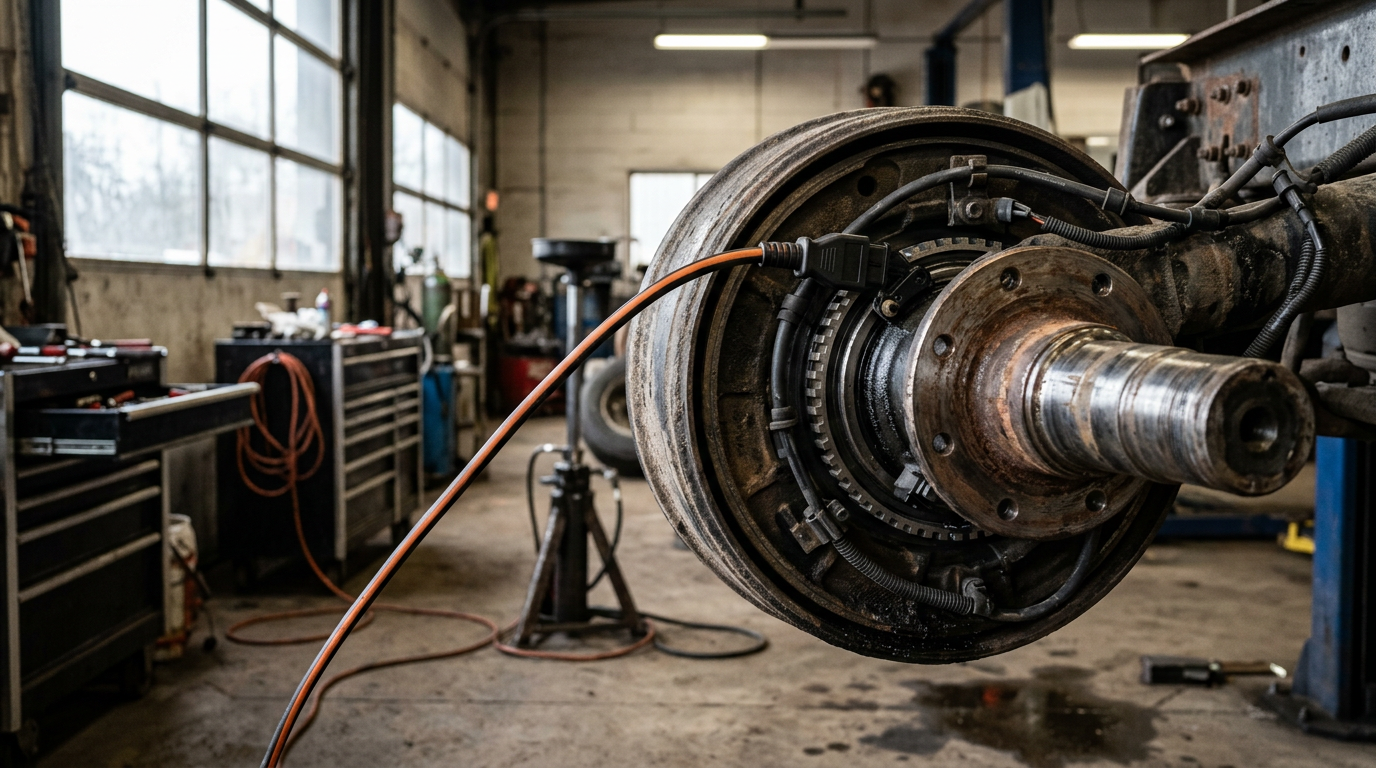
That ABS light on your trailer dash isn't just annoying — it means your trailer's brakes are running without anti-lock protection, and DOT will write you up for it at a roadside inspection. Nine times out of ten it's not the expensive stuff. It's a corroded connector, a sensor packed with brake dust, or a wire chafed through where the harness rubs against the frame.
The mistake most guys make is throwing parts at it — new wheel speed sensor, then a new ABS modulator valve, then finally checking the wiring after they've already spent the money. Work this the other way. Wiring and connectors fail way more often than the electronics inside the ECU, and they're free to check if you've got a test light and twenty minutes.
This guide walks you through isolating the fault — sensor, harness, or module — in the right order, so you're not guessing and you're not paying for parts you didn't need.
Step 1: Pull the Fault Code Before You Touch Anything
Every modern trailer ABS system stores fault codes even without a hand-held reader — most systems will flash the code through the ABS light itself if you jump the diagnostic pins per OEM spec, or you can pull codes with a basic trailer ABS reader.
The code tells you which wheel-end circuit is faulting — left front, right rear, whatever your axle config is. Don't skip this step. Chasing all four corners when the code points to one specific sensor circuit wastes your whole afternoon.
- Locate the ABS module (usually mounted near the front of the trailer, driver's side)
- Check for a diagnostic connector or blink code procedure per OEM spec
- Write down which axle/wheel-end circuit is flagged
- Note if it's an open circuit, short circuit, or signal fault — that changes where you look first
This narrows your search from "the whole trailer" to one harness run.
Step 2: Inspect the Connector at the Wheel End First
This is where most ABS faults actually live. The wheel speed sensor connector sits right down by the hub, exposed to road salt, brake dust, and wash-out water every single day. It's the first thing that corrodes.
- Unplug the connector and look for green or white corrosion on the pins
- Check for a cracked or split connector shell letting moisture in
- Look at the boot/seal — if it's torn, water's been getting in for a while
- Wiggle-test the connector while watching for the ABS light behavior (if you can monitor it)
A lot of "bad sensors" are actually just corroded pins. Clean corrosion with electrical contact cleaner and a wire brush, not sandpaper — you don't want to remove plating and make it worse. If the connector's cracked, replace it rather than taping it up. Dielectric grease on reassembly buys you real life out there.
Step 3: Check the Sensor Itself — Resistance and Air Gap
With the connector confirmed clean, test the wheel speed sensor itself. Pull it and check:
- Resistance — measure across the sensor leads with a multimeter, compare to OEM spec. Way out of range (open or shorted) means the sensor's dead
- Physical condition — cracked housing, chewed-through wire right at the sensor body, or a sensor tip that's worn down from rubbing the tone ring
- Air gap — the gap between the sensor tip and the tone ring/exciter ring needs to be within OEM spec. Too much gap and the signal's too weak for the ECU to read reliably
- Tone ring condition — check for missing teeth, rust buildup, or debris packed into the ring itself
A sensor that reads good resistance but has a chewed air gap will still throw an intermittent fault. Don't stop at resistance alone — check the mechanical fit too.
Step 4: Trace the Harness for Chafe Points and Opens
If the connector and sensor test good, the problem's in the harness run between the wheel end and the ABS module. This is the most time-consuming step but skipping it means you're guessing.
- Visually trace the harness along the axle and frame rail, looking for chafe points, pinch points near the suspension, or spots where it's rubbing on a moving part
- Check continuity end-to-end with a multimeter — an open circuit means a break somewhere in that run
- Look closely at any spliced repairs from previous work — bad splices are a common repeat-failure point
- Check ground points for corrosion; a bad ground can mimic sensor faults
Harnesses that run near the axle take the worst abuse — road debris, flexing, and heat cycling all work against them over time.
Step 5: Only Now Suspect the ABS Module
If the sensor checks good, the connector's clean, and the harness has continuity end-to-end with no shorts to ground or to each other, then the fault likely sits at the ABS ECU/modulator itself.
Modules fail way less often than sensors and harnesses — in most fleets it's a small fraction of ABS complaints. Before condemning it:
- Verify the module's getting proper power and ground per OEM spec
- Check that all wheel-end circuits are wired to the correct module terminals — a previous repair miswire will look exactly like a module fault
- Confirm the fault code specifically points to an internal module fault, not just "circuit fault" which usually still means wiring
Replacing an ABS module is real money. Make sure you've ruled out everything upstream first, and if you're not fully confident in your findings, get a certified tech to confirm before that part goes on the truck — ABS is a brake safety system, not a place to guess.
Quick answers
Can I keep driving with the trailer ABS light on?
Yes, your service brakes still work without ABS — you just lose anti-lock protection, which matters most in hard stops or slippery roads. It'll also get flagged at a DOT inspection, so get it fixed rather than running it long-term.
Why does my ABS light flicker only when it's wet or the trailer's been washed?
That's almost always a compromised connector or a crack in a sensor housing letting moisture in. Dry conditions let the corroded contact still make a marginal connection; moisture pushes it over the edge into an open circuit.
How do I know if it's the sensor or the tone ring?
A bad sensor usually reads out of spec on resistance; a bad tone ring or wrong air gap can happen even with a good sensor and won't show up on a resistance test alone. Always check the physical air gap and tone ring condition, not just electrical values.
Parts for this job
Real products from the PartsNow catalog. Confirm fitment with Mike before ordering.


Still not sure what's wrong?
Mike — the free AI truck consultant — will walk through your exact symptoms and point you to the right part. No account, English or Spanish, 24/7.
