Kingpin & Bushing Wear: Steer Axle Play Diagnosis Guide
July 14, 2026 · PartsNow Guides
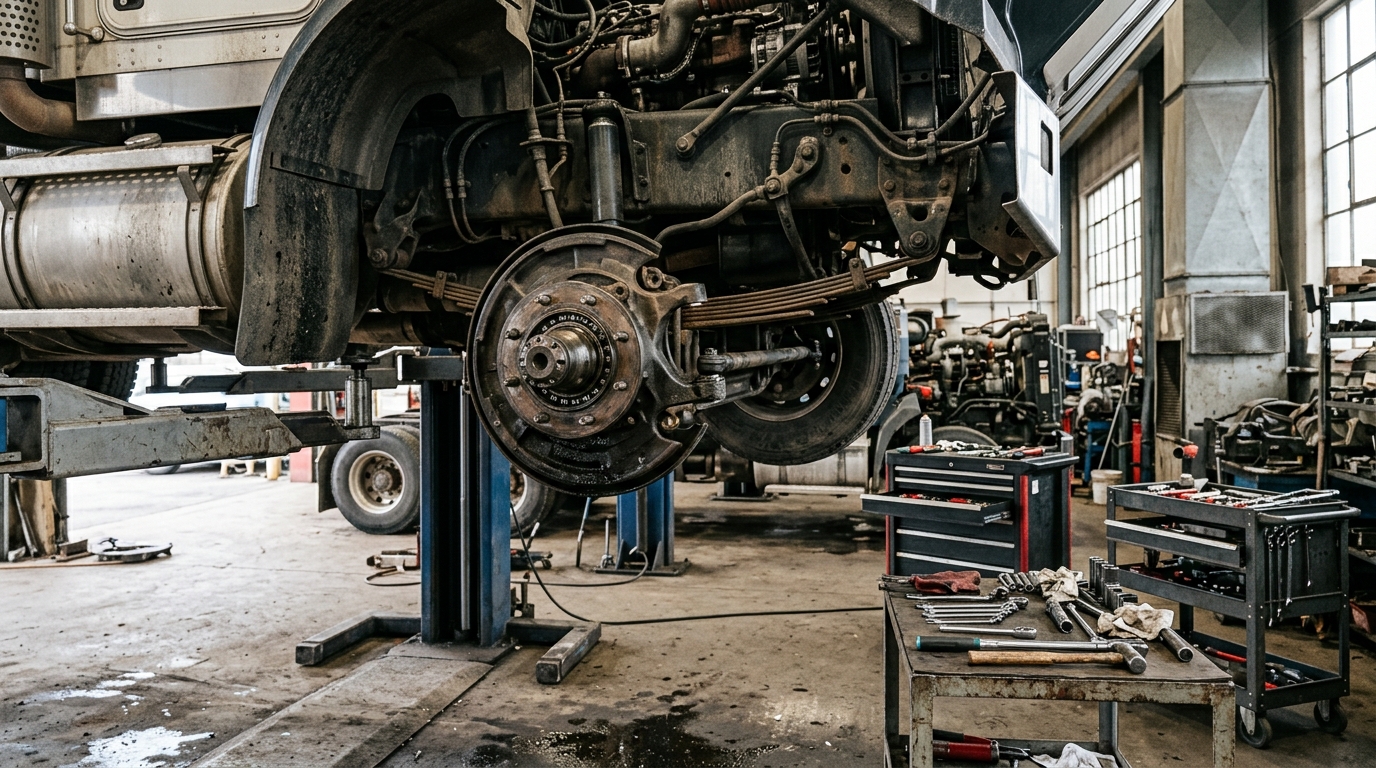
You feel it before you can name it — a little wander in the wheel, some shimmy over rough pavement, or the steering that feels loose right around center. Nine times out of ten on an older truck, that's kingpin and bushing wear talking to you, and it's not going to fix itself.
The problem is guessing doesn't cut it here. Steer axle play is a DOT out-of-service item once it exceeds spec, and eyeballing a wheel shake in the yard won't tell you if you're at .015" or .080". You need a dial indicator and five minutes to know for sure.
We'll walk through the check the way a shop foreman would show a new hire, using a Peterbilt 377 as our example since it's a common platform still working hard in a lot of fleets. Same method applies across most conventional steer axles.
Why Kingpins and Bushings Wear Out
The kingpin is the vertical pin that lets your steer axle knuckle pivot for turning. It rides inside bushings pressed into the knuckle bore, and that whole assembly carries the weight of the front end every mile you drive.
Grease intervals get missed, seals crack, dirt and water get in, and the bushings start wearing oval instead of round. On a Peterbilt 377 with a lot of miles on the original kingpin kit, this is one of the most common steer axle complaints we see.
Once wear sets in, you get play — the knuckle can rock front-to-back and up-and-down on the pin instead of pivoting clean. That play shows up as wandering, pulling, uneven tire wear, and eventually a shimmy that gets worse the faster you go.
Ignore it long enough and you're not just looking at a failed inspection — you're looking at a knuckle that can crack or a wheel-end that loses geometry entirely.
Tools You'll Need for the Dial Indicator Check
This isn't a guessing job — get the right gear before you start.
- Dial indicator with magnetic base, at least 1" of travel
- Jack and axle stands rated for the front axle weight
- Pry bar (long enough to get real leverage under the tire)
- Torque wrench if you're pulling anything apart afterward
- Grease gun to check for dry bushings while you're under there
Make sure the truck is on a flat, level surface with the front axle fully unloaded — wheels off the ground, not just the load lightened. Chock the rear wheels and set the parking brake before you jack anything. This is steer axle work, so treat it with the same respect you'd give brake work — one bad jack stand placement and you're not walking away clean.
Step-by-Step: Measuring Kingpin and Bushing Play
With the wheel off the ground and the tire still mounted:
- Mount the dial indicator's magnetic base to the axle beam, with the plunger tip resting against the bottom of the brake drum or rotor flange
- Zero out the indicator
- Have a helper insert the pry bar between the tire and the ground (or under the axle) and apply upward force on the bottom of the wheel, then release
- Read the total movement on the dial — that's your vertical kingpin/bushing play
- Repeat with the pry bar pushing the wheel fore-and-aft to check for horizontal play in the bushings
- Do both sides — wear is rarely even side to side
Write down both readings for each side. Compare against per OEM spec for your axle — Peterbilt 377s typically ran Rockwell or similar heavy-duty steer axles, and the service limit will be in the axle manufacturer's spec sheet, not a generic number you find online.
Reading the Numbers: Pass, Watch, or Replace
Once you've got your dial indicator readings, here's how to think about them:
- Within OEM spec — you're good, log it and recheck at your next PM interval
- Approaching the upper limit — this is a watch item. Grease it, recheck in a shorter interval, and start budgeting for a kingpin kit
- Exceeds OEM spec — this is a DOT out-of-service condition. Don't run it, don't wait for the next scheduled shop day
An inspector doing a roadside check is going to do essentially the same pry-bar-and-feel test you just did with more precision. If your numbers are over spec, they'll find it, and you'll be parked until it's fixed.
Don't split hairs on a number that's right at the line — if you're questioning whether it passes, that's your answer. Get it fixed before it becomes a decision made for you on the shoulder of I-80.
Kingpin and Bushing Replacement Is Safety-Critical Work
This is steering and wheel-end work — full stop. Kingpin and bushing replacement means pressing out old bushings, reaming to spec, pressing in new kingpins, and getting everything torqued correctly.
This job needs a certified tech's sign-off. Get it wrong and you've got a steer axle that can fail at speed — that's not a repair you learn on the fly in your driveway, even if you're mechanically capable of most of your own truck work.
If your dial indicator readings say you're out of spec, get the truck into a shop that does front axle work regularly, not the first bay that says yes. Ask what kit they're using and confirm they're pulling per OEM spec torque and clearance numbers — not eyeballing it.
Quick answers
How much kingpin play is too much for DOT inspection?
There's no single universal number — it depends on your axle manufacturer's spec, which is why you check **per OEM spec** for your specific axle. Anything measurably loose enough to feel with a pry bar during a roadside check is likely to get you flagged, so don't wait until it's obvious.
Can I drive with worn kingpins if I'm careful?
No. Worn kingpins mean unpredictable steering response, and that gets worse fast under load or at highway speed. This is a park-it-now issue, not a drive-it-gentle issue.
How often should I check kingpin and bushing wear on an older truck?
Check it at every PM interval once your truck's past 200,000 miles or if you've noticed any steering wander or shimmy. Trucks like the Peterbilt 377 running heavy regional or vocational duty cycles tend to wear kingpins faster than long-haul highway miles, so adjust your check frequency to your duty cycle.
Parts for this job
Real products from the PartsNow catalog. Confirm fitment with Mike before ordering.


Still not sure what's wrong?
Mike — the free AI truck consultant — will walk through your exact symptoms and point you to the right part. No account, English or Spanish, 24/7.
Related truck: Peterbilt 377— specs & parts
