Steering Gear Box Failure: Diagnosing Play, Leaks & Noise
October 15, 2026 · PartsNow Guides
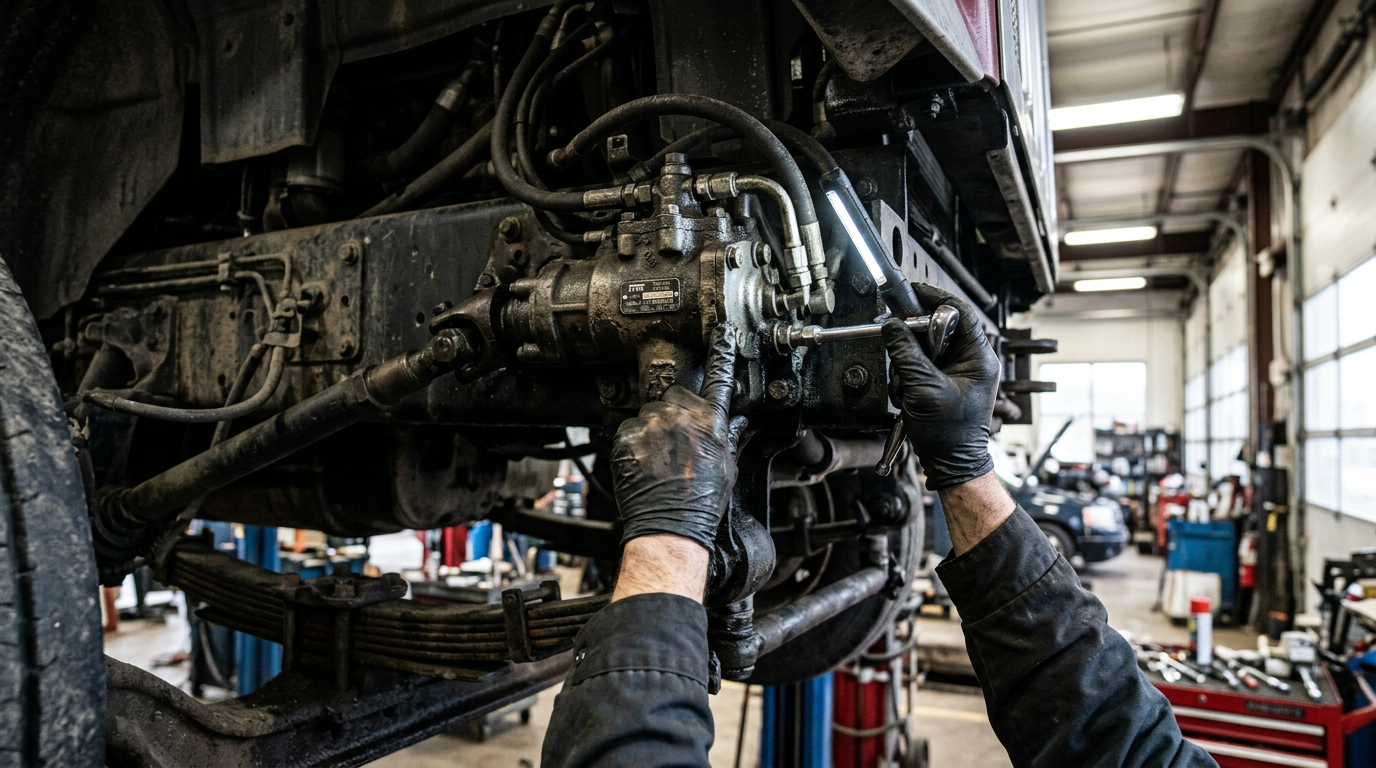
You feel it before you can explain it — the wheel's got more slop than it used to, maybe an inch or two of dead travel before the front end actually responds. Or there's a dark patch of gear oil showing up on the frame rail under the cab. Or that low grinding sound when you crank the wheel hard at low speed in the yard. All three are the steering gear box talking to you, and none of them get better on their own.
A bad steering gear box doesn't fail quiet. It telegraphs trouble for weeks before it becomes a roadside inspection headache or worse — a steering failure at highway speed. The problem is a lot of drivers and even some techs write off play and noise as "just an old truck" instead of pulling the box and checking it against spec.
This guide walks through how to diagnose gear box wear the way an experienced tech would — checking play at the wheel versus play at the box, tracing leaks to their actual source, and telling the difference between a worn sector shaft and a bad mount. We'll anchor some of this to the Kenworth T380/T480 platform since that's a common box in a lot of fleets, but the diagnostic process applies across most recirculating-ball gear boxes on Class 8 trucks.
This is steering system work. Any adjustment, rebuild, or replacement on a steering gear box needs sign-off from a certified tech — this is not a bay you want a guess in.
Checking for Excess Steering Play
FMCSA has a hard line on this: more than 2 inches of play at the steering wheel (measured at the rim, engine running, wheels pointed straight) is an out-of-service condition on most trucks. Before you blame the gear box, rule out other suspects.
- Check the pitman arm nut torque and look for movement between the arm and sector shaft
- Inspect tie rod ends and drag link for play by hand with the truck on the ground
- Look at steering column u-joints — worn joints feel just like gear box slop from the driver's seat
- Have a second person turn the wheel slightly while you watch the pitman arm — if the arm doesn't move until the wheel's turned several degrees, the play is in the box itself
On a T380/T480, the gear box mounts to the frame rail with bolts that need to be checked to OEM spec — a loose mount will mimic internal gear wear and send you chasing the wrong problem. Don't adjust the box's internal mesh to "fix" play caused by a loose mount; you'll mask the real issue and could overtighten the sector mesh, which accelerates wear.
Tracing Fluid Leaks to the Source
Power steering fluid on the frame rail doesn't always mean the gear box itself is bad — but it's where most techs should start looking.
- Input shaft seal — leaks here show up as fluid tracking down from where the steering shaft enters the box
- Sector shaft seal — leaks collect near the pitman arm connection, often mistaken for gear oil from the drive axle
- Side cover gasket — a slow weep along the cover bolt line, usually from age or over-torque warping the cover
- Fittings and hose connections — check these before you condemn the box; a loose fitting is a five-minute fix, not a rebuild
Wipe everything down, drive the truck, and recheck. Fresh fluid pinpoints the actual source faster than guessing from residue buildup. If the leak's coming from the sector shaft seal, that's usually a sign of internal wear pushing fluid past the seal under load — not just a bad seal on its own. That combination is a strong signal you're heading toward a rebuild or replacement, not just a seal swap.
Diagnosing Grinding or Groaning Noise
Noise under hard steering input — especially at low speed, full lock — points to a few specific causes, and they don't all mean the box is shot.
- Low fluid level or aerated fluid causes a whine or groan; check the reservoir and bleed the system first
- Worn pump can sound almost identical to a bad gear box — isolate by listening with the pump belt removed and hand-turning (only with engine off and proper lockout)
- Worn ball bearings or sector gear mesh inside the box produces a grinding or rough feel that you can sometimes feel through the wheel as well as hear
- Pressure relief valve issues inside the box can cause noise under load that goes away at idle turns
If you've ruled out the pump and fluid condition and the grinding is specific to full-lock turns, that's internal gear box wear. At that point you're deciding between rebuild and replacement, which comes down to how far gone the sector shaft and ball nut assembly actually are — not something to eyeball from outside the housing.
Rebuild vs. Replace: Making the Call
This is where a lot of shops waste money either way — rebuilding a box that's too far gone, or replacing one that just needed a seal kit.
- Rebuild candidates: isolated seal leaks, minor adjustment-correctable play, housing in good shape with no cracks or corrosion
- Replace candidates: worn sector shaft teeth, pitted ball bearing races, housing damage, or a box that's already been rebuilt once and is failing again
- Mileage and duty cycle matter — a T380 running regional with moderate steering input ages differently than a vocational truck doing constant tight-radius work
- Labor cost is often the deciding factor — pulling and reinstalling a gear box takes similar labor whether you rebuild or replace, so if the core's marginal, replacement is usually the better long-term call
Get the torque specs for pitman arm nut, mounting bolts, and sector shaft adjustment from OEM spec documentation specific to the gear box model — these aren't interchangeable across box manufacturers even on the same truck platform. Any internal adjustment or replacement needs sign-off from a certified steering/suspension tech before the truck goes back in service.
Pre-Trip and PM Checks That Catch It Early
Most gear box failures don't happen overnight — they show up in PM inspections first if someone's actually looking.
- Add a steering play check to every PM interval, not just annual inspections
- Log fluid level and condition at every oil change — dark, burnt-smelling fluid means heat cycling that accelerates seal wear
- Check mounting bolt torque at scheduled intervals, especially on trucks running rough terrain or heavy vocational work
- Train drivers to report any change in steering feel immediately, not just when it gets bad enough to notice
Catching a worn gear box at the "slight play" stage versus the "grinding and leaking" stage is the difference between a scheduled repair and an unscheduled roadside call. On fleets running T380/T480s in mixed service, building this into the standard PM checklist costs a few extra minutes and saves a lot of downtime.
Quick answers
How much steering wheel play is too much on a semi truck?
FMCSA's out-of-service standard is more than 2 inches of play measured at the wheel rim with the engine running and wheels straight. If you're over that, the truck shouldn't be on the road until a certified tech inspects and corrects it.
Can a steering gear box be adjusted instead of replaced?
Yes, in some cases — if the play is from the sector shaft mesh adjustment and not worn internal components, a tech can adjust it to **OEM spec**. But if you've already got grinding noise or seal leaks, adjustment alone won't fix the underlying wear.
What does a bad steering gear box sound like?
Typically a grinding or groaning noise concentrated at full-lock turns, especially at low speed — different from pump whine, which tends to happen across the whole steering range rather than just at the extremes.
Is a power steering fluid leak always the gear box?
No — check hose fittings, the pump, and the reservoir first since those are simpler fixes. But a leak specifically at the sector shaft seal combined with any play or noise usually points to internal gear box wear, not just a bad seal.
Will a worn steering gear box fail a DOT inspection?
Yes, if steering play exceeds the FMCSA limit or there's visible leaking affecting steering performance, it's an out-of-service violation. Fluid leaks and play should be corrected before the truck goes through an inspection, not after.
Parts for this job
Real products from the PartsNow catalog. Confirm fitment with Mike before ordering.


Still not sure what's wrong?
Mike — the free AI truck consultant — will walk through your exact symptoms and point you to the right part. No account, English or Spanish, 24/7.
Related truck: Kenworth T380 / T480— specs & parts
