Leaf Spring Sag and Replacement: Diagnosing Ride Height
September 8, 2026 · PartsNow Guides
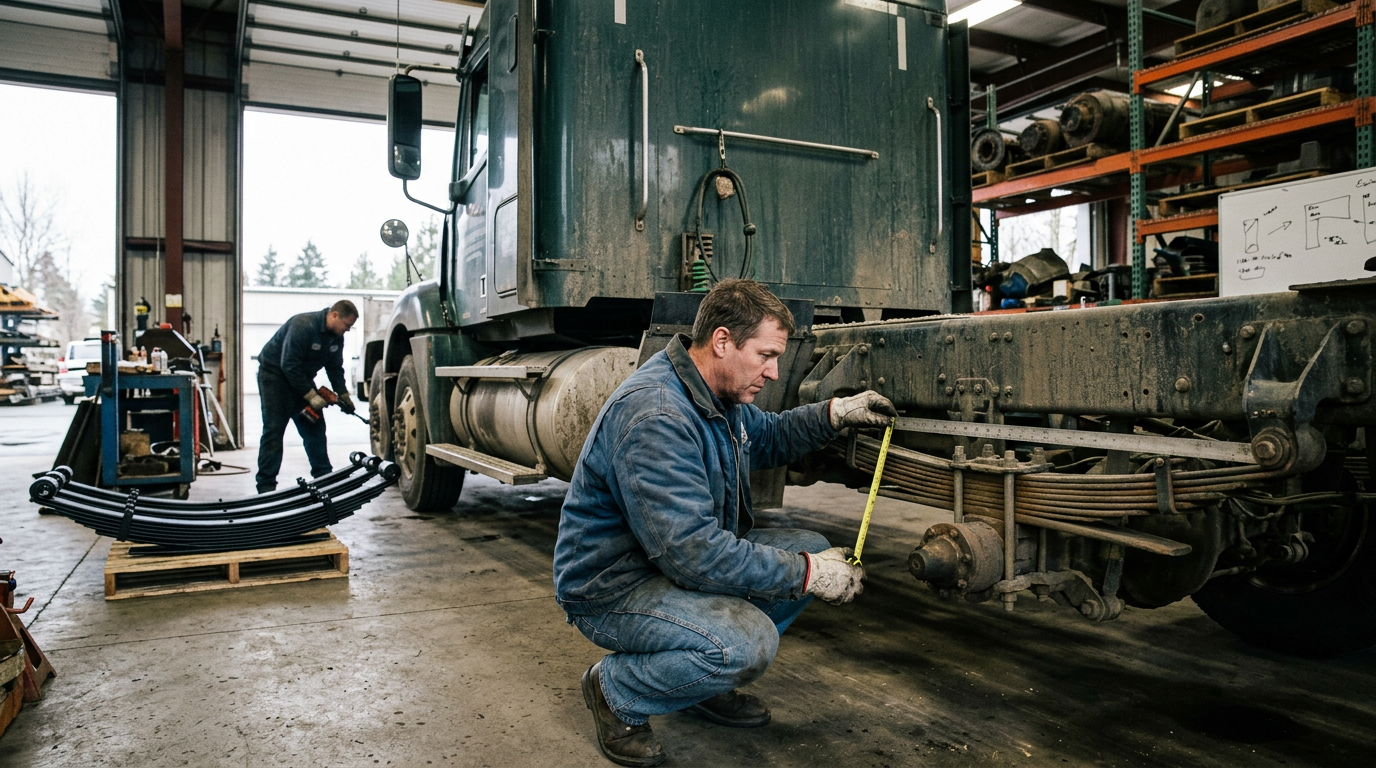
You climb up into the cab and something feels off — the truck's sitting lower on one corner, or it's riding stiffer than it used to and every bump in the road rattles your teeth. Nine times out of ten when a fleet mechanic gets that complaint, it traces back to the leaf springs. They don't fail all at once usually — they sag a little at a time until one day you notice the frame's closer to the axle than it should be, or you spot a leaf poking out where it shouldn't.
Sagging leaf springs aren't just a comfort issue. They throw off your ride height, mess with alignment, load distribution, and can put extra stress on brake lines, u-joints, and driveshaft angles. A truck riding low up front or hiked up in the back is a truck that's working against itself — and against your fuel mileage.
This guide walks through how to spot the signs of a tired leaf spring, how to actually measure ride height instead of eyeballing it, and how to choose a replacement pack that matches your application instead of guessing off a parts counter recommendation.
Signs Your Leaf Springs Are Sagging or Broken
Start with a walk-around before you ever put the truck on a lift. Uneven stance — one corner sitting lower than the others — is the most obvious tell. Stand back 15-20 feet and look at the truck square from the side and rear.
Other signs to check for:
- Visible gap or separation between leaves in the pack, especially near the center bolt
- Rust streaks or shiny wear marks where leaves are rubbing against each other abnormally
- A leaf sticking out past the edge of the pack — this usually means one has cracked
- Clunking or popping noises over bumps, which often means a broken leaf shifting
- Uneven or accelerated tire wear on one side, a downstream symptom of a sagged spring changing your alignment geometry
- Bottoming out on moderate bumps when loaded, when it never used to
If you find a fully broken leaf, don't drive it any further than you have to. A broken main leaf especially can lead to loss of axle control.
How to Measure Ride Height the Right Way
Eyeballing it gets you in the ballpark, but if you're diagnosing sag for a warranty claim or trying to decide if a spring needs replacing, you need real numbers.
- Park on a flat, level surface — this matters more than people think, even a slight grade throws off your reading
- Measure from a fixed reference point on the frame straight down to the center of the axle, or to the ground depending on OEM spec
- Take the measurement on both sides and compare side-to-side, not just against a spec sheet
- Check the load — measure empty and loaded if you can, since some sag only shows up under weight
- Compare your numbers against OEM spec for that make, model, and axle position — front and rear specs are different, and steer vs. drive axle specs are different too
Write down what you find. A half-inch difference side to side is worth investigating. An inch or more, and you're looking at a spring that's done its job and needs replacing.
Front vs. Rear Spring Considerations
Front leaf springs and rear leaf springs don't fail the same way or get replaced for the same reasons, so don't treat them identically.
Front springs carry steering geometry along with weight. Sag up front changes caster angle, which affects steering feel and tire wear fast. If you're seeing cupped or feathered tire wear along with a low front end, the spring is likely part of the problem — but remember, steering geometry work is safety-critical and any adjustment or diagnosis tied to steering angles should get signed off by a certified tech.
Rear springs typically deal with more raw load-carrying duty, especially on straight trucks and trailers. Sag here shows up more in ride height and axle wrap under acceleration/braking than in steering feel.
When you're replacing one side, seriously consider replacing the pack on the other side too, even if it's not showing the same wear. Springs age together under the same duty cycle, and mismatched stiffness side-to-side creates handling that's uneven under load or in a hard stop — again, tie this back to a qualified tech since it touches braking and handling behavior.
Choosing the Right Replacement Leaf Spring Pack
This is where a lot of guys get burned buying based on price or a rough cross-reference instead of the actual application.
- Match the capacity rating to your GAWR (gross axle weight rating), not just what fits physically — an undersized pack will sag again fast under real load
- Match leaf count and arch to OEM spec for your chassis; more leaves isn't automatically better if it changes your ride height or spring rate outside of what the axle and steering geometry were designed around
- Check taper leaf vs. multi-leaf design — taper leaf packs ride softer and lighter but aren't always rated for the same capacity as multi-leaf in heavy-haul use
- Verify eye-to-eye length and mounting style matches your hanger and shackle setup exactly — this isn't a spot to eyeball a close match
- Buy from a supplier who can confirm the pack against your VIN or axle tag spec, not just a generic size chart
When in doubt, pull the tag off your old spring or axle and match specs directly rather than going off memory or a rough visual comparison.
Installation and Alignment Follow-Up
Swapping a leaf spring pack isn't just unbolt-and-bolt-back-on. Once new springs are in, ride height, axle alignment, and often wheel alignment need to be checked and corrected. New springs sit differently than worn ones, and that changes pinion angle, caster, and toe.
- Torque all U-bolts and hanger bolts to per OEM spec — under-torqued U-bolts are a common cause of leaf spring pack failure shortly after replacement
- Re-check ride height after installation and let the truck settle overnight before final measurements if possible
- Get a full alignment check afterward, especially on steer axles
- Inspect and replace worn bushings, shackles, and pins while you're in there — reusing worn hardware on a new spring pack is a false economy
Because this work directly affects wheel-end stability, steering control, and braking behavior under load, final installation and alignment should be signed off by a certified tech before the truck goes back in service.
Quick answers
How do I know if my leaf spring is broken vs just sagging?
A broken leaf usually shows a visible gap, a leaf sticking out past the pack, or a popping/clunking noise over bumps. Sagging without a break looks more like a gradual drop in ride height with no visible separation between leaves — check both with a ride height measurement against OEM spec.
Can I drive with a sagging leaf spring?
Short distances at reduced load and speed are generally okay, but sag changes alignment and load distribution, which accelerates tire wear and stresses other components. If a leaf is actually broken, get it inspected by a certified tech before continuing to drive it.
Do I need to replace leaf springs in pairs?
It's strongly recommended. Springs on both sides of an axle wear together under the same duty cycle, and mismatched stiffness side-to-side can cause uneven handling, especially during hard braking or cornering.
How much sag is too much on a leaf spring?
There's no single number across all trucks — it depends on OEM spec for that axle position. As a rule of thumb, a side-to-side difference of an inch or more, or a noticeable change from the vehicle's original ride height spec, means it's time to replace.
Will new leaf springs fix uneven tire wear?
If the tire wear is caused by sag-related alignment changes, new springs can help, but you should get a full alignment check after installation to confirm caster, camber, and toe are back in spec — new springs alone don't guarantee correct alignment.
Parts for this job
Real products from the PartsNow catalog. Confirm fitment with Mike before ordering.


Still not sure what's wrong?
Mike — the free AI truck consultant — will walk through your exact symptoms and point you to the right part. No account, English or Spanish, 24/7.
