Steer Tire Wear Patterns: What They're Telling You About Alignment
July 16, 2026 · PartsNow Guides
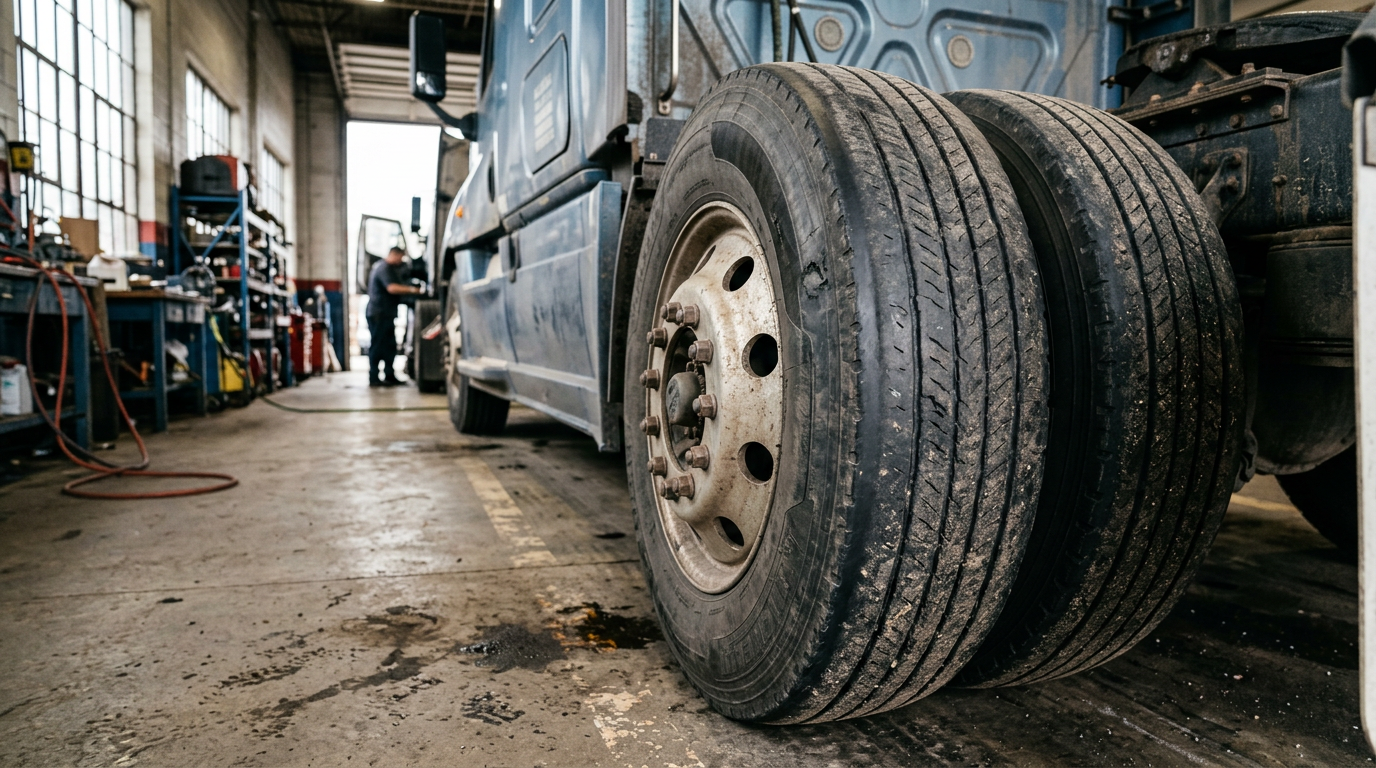
Your steer tires are talking to you every single day. Problem is, most guys don't stop long enough to listen until they're standing on the shoulder with a shredded casing and a DOT officer walking up. Cupping, feathering, one-sided edge wear — none of that happens by accident. It's your front end telling you something's bent, loose, worn out, or out of spec.
On a Freightliner Cascadia, the independent front suspension and rack-and-pinion steering make alignment issues show up fast on steer rubber — sometimes in as little as 15,000-20,000 miles if something's off. Ignore the pattern and you're not just burning through tires early, you're driving on a front end that could let go at highway speed.
This guide breaks down the most common wear patterns, what's actually causing them, and when it's a shop-vac-and-air-gauge job versus a get-a-certified-tech-under-the-truck job.
Why Steer Tires Are the Canary in the Coal Mine
Steer axle tires carry the load of every alignment angle you've got — caster, camber, toe, kingpin condition, even worn bushings. Drive and trailer tires can hide a lot of sins because they're not steering the truck. Steer tires can't hide anything.
That's why a smart shop checks steer tire wear before it checks anything else when a driver complains about pulling, wander, or vibration. The tread is a record of everything the front end has been doing for the last several thousand miles.
On the Cascadia, with its lighter front axle weight and independent suspension geometry, wear shows up quicker than on older conventional setups. A driver who ignores early feathering or cupping is looking at premature tire replacement — and possibly a front-end component that's about to fail completely. Catching the pattern early is cheaper than any tow bill or blowout claim you'll ever file.
Quick-Reference Wear Pattern Chart
Here's the fast version — match what you're seeing to the likely cause, then dig deeper in the sections below.
| Wear Pattern | Looks Like | Likely Cause |
|---|---|---|
| Feathering | Sharp edge on one side of each tread block, smooth on the other (feels like a saw blade running your hand across it) | Toe misalignment |
| Cupping/Scalloping | Scooped-out dips spaced around the tire, uneven | Worn shocks, loose suspension components, out-of-balance tire |
| One-sided edge wear (inner) | Excess wear on inside shoulder | Excess negative camber, worn kingpin bushings, bent axle |
| One-sided edge wear (outer) | Excess wear on outside shoulder | Excess positive camber, overloading, hard cornering |
| Center wear | Wear concentrated down the middle | Overinflation |
| Both-edge wear | Wear on both shoulders, center still good | Underinflation |
This is a starting point, not gospel. Confirm with an alignment reading before you start swapping parts.
Feathering: The Toe Misalignment Signature
Run your palm across the tread from inside to outside. If it feels smooth one way and rough or sharp the other, you've got feathering — and that's almost always toe misalignment. Toe-in wears the outside edges sharp; toe-out wears the inside edges sharp.
On a Cascadia, toe gets knocked out of spec from curb strikes, potholes, or just normal wear on tie rod ends and the steering linkage over time. It's one of the more common alignment faults because toe is the angle most sensitive to bumps and impacts — way more sensitive than camber or caster.
Good news: feathering caught early is a relatively cheap fix. An alignment check and adjustment per OEM spec usually solves it. Left alone, feathered tires wear out fast and can start affecting handling and fuel economy. If tie rod ends or steering linkage components are worn beyond spec, that's steering-system work and needs a certified tech's sign-off before the truck goes back on the road.
Cupping and Scalloping: Suspension and Balance Trouble
Cupping shows up as a series of dips or scoops around the tire, sometimes called scalloping when they're more pronounced. Run your hand around the circumference — if it feels like a wave instead of a smooth arc, that's cupping.
This pattern usually points to worn shock absorbers, loose or worn suspension bushings, a bent or worn kingpin, or a wheel/tire that's out of balance. On the Cascadia's front end, worn shocks are a common culprit — they let the tire bounce instead of staying planted, and every bounce takes a little bite out of the tread.
Don't just balance the tire and call it done if the cupping is severe or spread across multiple tires. That's a sign of a mechanical issue underneath, not just a rubber problem. Suspension and kingpin inspection should be done by a certified tech — kingpins and steering-linked components are safety-critical, and worn ones can lead to loss of steering control.
One-Sided Edge Wear: Camber, Kingpins, and Overloading
If one shoulder of the tire is chewed up more than the other, look at camber first. Excess negative camber (top of tire tilted in) eats the inside shoulder; excess positive camber (top tilted out) eats the outside shoulder.
But camber isn't the only suspect. Worn kingpin bushings, a bent steering knuckle, or a sagging leaf spring can all throw camber out of spec even if the truck was aligned correctly to start. On a loaded Cascadia, overloading the front axle beyond its rating will also accelerate outer edge wear from the tire flexing more than it should.
Don't chase this with an alignment alone if the wear is severe or asymmetrical between left and right. Get the kingpins and steering knuckle checked for play — per OEM spec — before adjusting camber, because adjusting angles on a worn front end just masks the real problem. Kingpin and steering knuckle work is safety-critical and needs a certified tech's inspection and sign-off.
When to Stop Guessing and Call a Certified Tech
Reading tread wear gets you 80% of the way to a diagnosis, but it doesn't replace an actual alignment check with proper equipment. If you're seeing any of these, it's time to get the truck on a rack:
- Wear pattern doesn't match steering feel (pulling, wander, vibration)
- Cupping or scalloping on more than one tire
- Any play felt when checking kingpins or tie rod ends by hand
- Wear that returns quickly after a tire swap or previous alignment
Alignment, kingpin, and wheel-end work are safety-critical systems. A bad reading, a missed worn bushing, or an alignment done on a front end with hidden play can leave you with a truck that looks fine on paper but isn't safe at speed. Any suspicion of kingpin wear, steering linkage play, or wheel-end looseness should go to a certified tech for inspection and sign-off — this isn't a parking lot fix.
Quick answers
Can I keep driving on a tire with heavy cupping?
Not for long. Cupping usually means something in the suspension is letting the tire bounce instead of tracking smooth, and that same issue can affect steering control. Get it inspected before you rack up more miles — the tire wear is the symptom, not the actual problem.
How often should I check steer tire alignment on a Cascadia?
Check tread wear visually at every PM interval, and get a full alignment check per OEM spec any time you replace steer tires, hit a pothole hard, or notice pulling or wander. Waiting for scheduled service alone can let small toe or camber issues turn into expensive wear.
Will rotating tires fix feathering?
No — rotating just moves the problem around, it doesn't fix the toe misalignment causing the feathering in the first place. You need an actual alignment correction, and the new tire will feather again if the root cause isn't addressed.
Parts for this job
Real products from the PartsNow catalog. Confirm fitment with Mike before ordering.


Still not sure what's wrong?
Mike — the free AI truck consultant — will walk through your exact symptoms and point you to the right part. No account, English or Spanish, 24/7.
Related truck: Freightliner Cascadia— specs & parts
