Slack Adjuster & Brake Chamber Problems: Diagnosis Guide
July 19, 2026 · PartsNow Guides
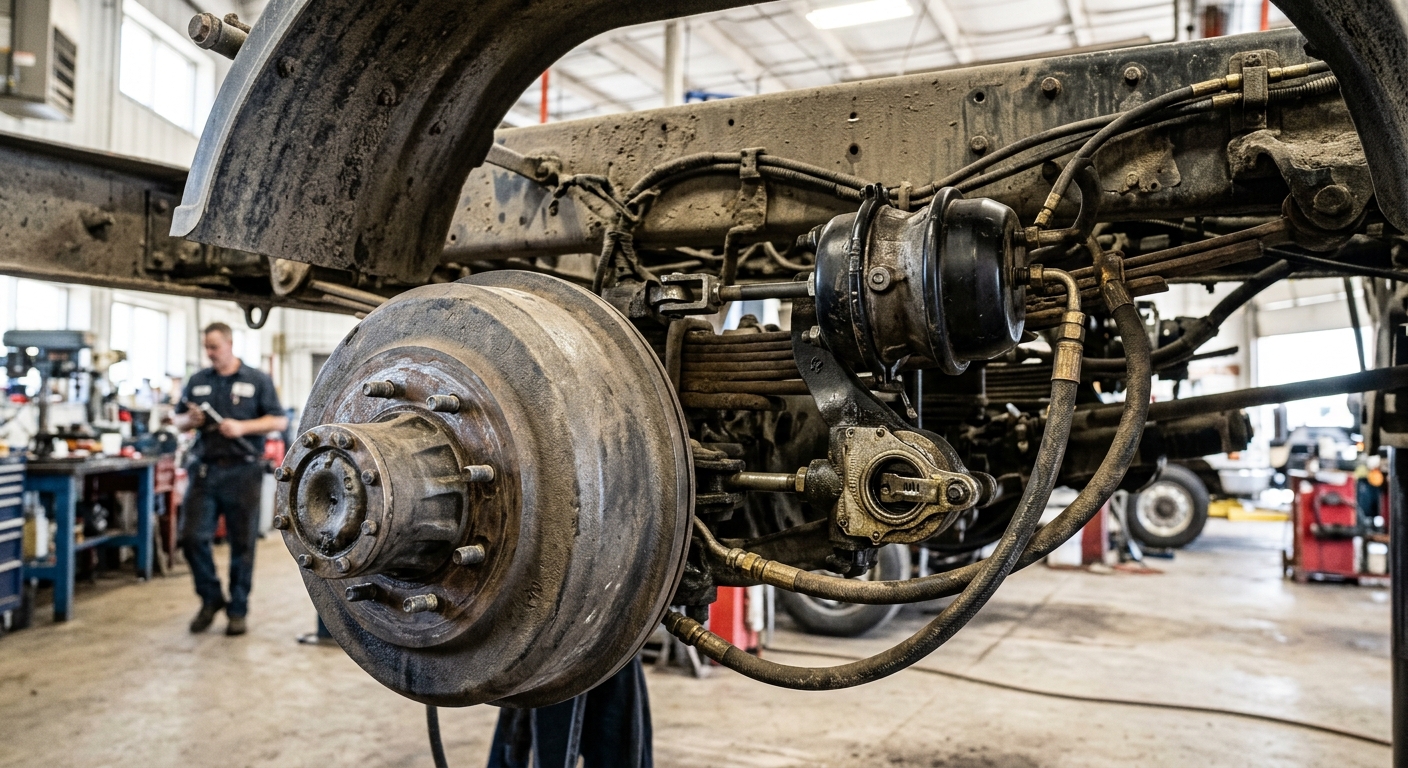
You're pulling to one side under braking, or a wheel's running hot on the trailer axle, and you already know what that means for your CSA score if you don't catch it first. Nine times out of ten it traces back to one of three things: a slack adjuster that's lost its grip, a brake chamber that's weak on the return, or pushrod stroke that's crept past spec without anybody noticing.
The trouble is these three problems mimic each other. A dragging brake can look like a bad chamber when it's really a slack adjuster that stopped auto-adjusting months ago. A pull under hard braking can look like alignment when it's actually one chamber losing air pressure faster than its neighbor. Guessing wrong means you're throwing parts at a truck that still fails the next roadside check.
This guide walks through how to tell the difference — manual versus automatic slack adjusters, how to check pushrod travel the right way, and when you adjust versus when you replace. We'll use the Kenworth T800 as our reference truck since it's common in vocational and heavy-haul fleets and shows this wear pattern a lot. Any hands-on brake adjustment or chamber swap is safety-critical work — have it verified by a certified tech before the truck goes back on the road.
Manual vs. Automatic Slack Adjusters — Know What You're Working On
Before you diagnose anything, confirm which type you've got. Manual slack adjusters need a wrench and a set procedure every time brake shoes wear — if nobody's been doing that on schedule, stroke creeps out fast. Automatic slack adjusters (ASAs) are supposed to self-adjust every time the brakes are applied, so if you're seeing excessive stroke on a truck with ASAs, something's already wrong internally — a seized internal clutch mechanism, worn actuator gear, or a control arm that's not moving through full travel.
On a Kenworth T800 running ASAs from the factory, if you find yourself needing to manually crank down the adjustment more than once, that's your signal the auto-adjust mechanism has failed, not that the shoes are just worn. Don't keep manually correcting an automatic slack adjuster as a permanent fix — that's a band-aid that hides a part that needs replacing. Log which axles have manual versus auto units before you start pulling measurements, because your diagnostic path splits from there.
Checking Pushrod Travel — Your First Diagnostic Step
Pushrod stroke tells you more than almost any other single measurement on the brake system. With the brakes fully released, mark the pushrod at the chamber. Have a second person make a full brake application and hold it, then measure the distance the rod traveled out of the chamber.
- Compare the reading against the chamber's stroke limit per OEM spec — it varies by chamber size (type 20, 24, 30, etc.)
- Check every wheel end, not just the one you suspect — a hot wheel on one side often means the other side is dragging, not the hot one failing
- Do this with the system at full operating air pressure, not just cracked open
If a wheel end is at or past the stroke limit, that brake is out of adjustment or the slack adjuster/chamber combo can't take up slack anymore. This is the number that decides your next move — adjust, or replace. This measurement is safety-critical; have a certified tech confirm it before returning the truck to service.
Reading the Symptoms: Drag, Pull, or Slow Release
The way the truck behaves narrows down the culprit before you even pull a wheel.
- Constant drag or a hot wheel/drum — usually a slack adjuster stuck in an over-adjusted position, or a brake chamber return spring that's weakened and not pulling the pushrod back fully
- Pull to one side under hard braking — almost always uneven chamber pressure or stroke between the left and right side of an axle, not a slack adjuster issue alone
- Slow to release after you let off the pedal — points to the chamber diaphragm or the ASA's internal clutch not resetting properly
- Grabby or uneven pedal feel with no other symptoms — check for a slack adjuster that's loose on the camshaft spline, which lets stroke wander even when everything else measures fine
Write down exactly what the truck is doing before you touch anything — it saves time chasing the wrong part.
Adjust or Replace? Making the Call on the Slack Adjuster
If a manual slack adjuster is out of spec but the adjuster body itself moves freely, turns smoothly, and holds its position — adjust it per OEM spec and recheck stroke. That's a legitimate fix, not a workaround.
Replace the slack adjuster when you find:
- Excessive play or wobble on the camshaft spline
- An ASA that won't self-adjust even after a full brake cycle with the truck moving
- Visible cracking, rust-seizing, or a bent arm
- Repeated need to manually correct an automatic unit
On a fleet truck like a T800 running regular routes, a slack adjuster that needs monthly manual correction is costing you more in labor and inspection risk than a replacement unit costs upfront. Don't keep re-adjusting a part that's supposed to be self-maintaining — that's the pattern that ends in a roadside brake-adjustment violation. Have a certified tech sign off on the replacement and re-verify stroke afterward.
Brake Chamber Failure Signs You Shouldn't Ignore
The brake chamber does the actual work of pushing the pushrod — if it's weak, no amount of slack adjuster tuning will fix your drag or pull.
- Visible air leaks at the clamp band or diaphragm seam — soap-and-water test if you can't hear it
- Slow to build or slow to release compared to the same axle's other side
- Weak spring brake application — the truck creeps or doesn't hold on a grade the way it should
- Rust staining or bulging on the housing, especially on chambers that have sat exposed to road salt
A chamber that's leaking or has a failing diaphragm needs replacement — there's no field adjustment for that. Pair the new chamber with a stroke check afterward, since a fresh chamber with a worn slack adjuster will just reintroduce the same drag problem. Brake chamber and spring brake work is safety-critical — this is signed-off work for a certified tech, not a shortcut job.
Quick answers
How do I know if my slack adjuster is manual or automatic without pulling it apart?
Look for an adjustment screw or hex head on the body — manual units have one you turn with a wrench. Automatic slack adjusters usually have a control arm linked to the brake chamber bracket and no manual adjustment point for routine use.
Can I just manually adjust an automatic slack adjuster to get by?
You can in a pinch, but if you're doing it more than once, the ASA has failed internally and needs replacement — repeated manual correction is a temporary patch, not a fix, and it'll get flagged on inspection again.
What pushrod stroke measurement means I'll fail a DOT inspection?
It depends on your chamber size — check the stroke limit per OEM spec for that specific chamber type. Any wheel end at or beyond its limit is an out-of-adjustment violation, so measure every wheel end before you're on the scale, not after.
Parts for this job
Real products from the PartsNow catalog. Confirm fitment with Mike before ordering.

3030HNTRX
3030HNTRX - 3030 SPEC LONG SHAFT HNTRX BRAKE CHAMBER
$84.04

2424T
2424T - TYPE 2424 BRAKE CHAMBER COMPLE
$150.00

OTR10143
OTR10143 - AUTO SLACK ADJUSTER, 11/2-10DRIVE 5.5,6.5
$150.00

R801074
R801074 - AUTO SLACK ADJUSTER, 28 SPLINE
$111.25

400-10141
400-10141 - AUTO SLACK ADJUSTER HALADEX
$222.50

3030LSX
3030LSX - 3030 LONG STROKE CHAMBER
$105.05

5-808330
5-808330 - BRAKE KIT FOR 4709DEN SHOES
$14.38

NB2001KIT-FRUE
NB2001KIT-FRUE - BRAKE SHOE KIT
$131.60
Still not sure what's wrong?
Mike — the free AI truck consultant — will walk through your exact symptoms and point you to the right part. No account, English or Spanish, 24/7.
Related truck: Kenworth T800— specs & parts
