Brake Chamber & Slack Adjuster Failure: Diagnosis Guide
October 13, 2026 · PartsNow Guides
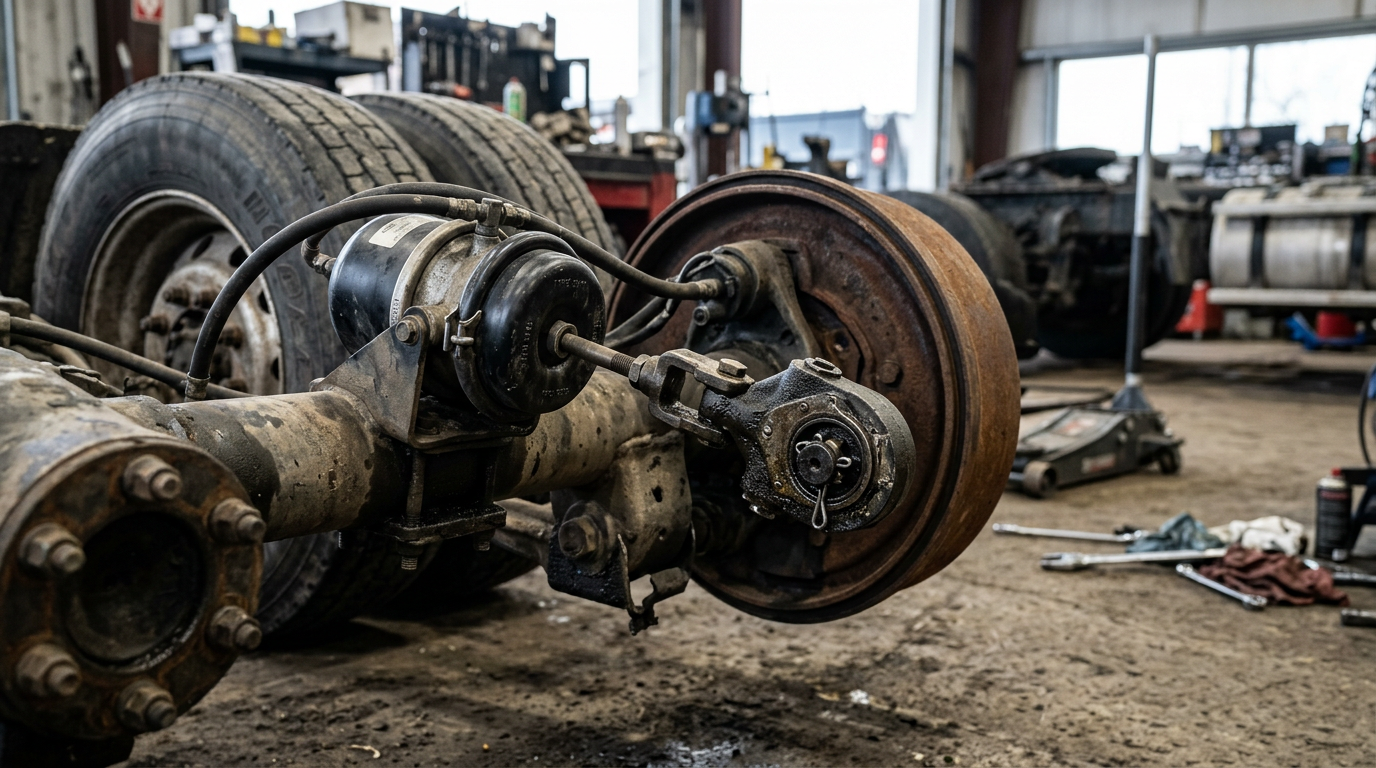
If you've ever felt your rig pull to one side under hard braking, or heard a brake drag on a trailer axle that shouldn't be dragging, you've already met the early warning signs of a slack adjuster or brake chamber on its way out. These parts don't usually fail all at once — they walk out of adjustment slowly, chamber by chamber, until one day a DOT inspector's gauge tells you what your gut already suspected.
The problem is that a lot of fleets and owner-operators treat slack adjusters and chambers as "set it and forget it" hardware. They're not. Automatic slack adjusters (ASAs) still wear, chambers still lose their seal, and push-rod travel still creeps out past spec even on trucks that get regular PMs. On a Kenworth T380 or T480 running mixed city/highway miles, that creep can happen faster than you'd think, especially with heavy stop-and-go duty cycles.
This guide walks through how to actually check push-rod travel the right way, what a failing chamber feels and sounds like, how to tell when an ASA is worn out versus just needing a reset, and where the line is between a quick adjustment and a parts swap. Brake work is safety-critical — if you're not a certified tech or you're unsure of a measurement, get a qualified brake tech to verify before the truck goes back on the road.
How to Spot a Failing Brake Chamber
A brake chamber that's going bad rarely fails silently. Listen for a hissing sound near the axle when you apply the brakes — that's air escaping past a cracked diaphragm or a bad clamp seal. Visually check for rust streaks or bubbling paint around the chamber housing, which usually means moisture has gotten past the seal and is corroding the internals.
On a T380 or T480 with air disc or drum setups, pull the dust plug on the non-pressure side and check for air or fluid weeping — that's a sign the diaphragm has torn. A chamber that's lost pressure will also show up as weak or uneven braking on that wheel end, sometimes pulling the truck to one side under hard stops.
Don't ignore a chamber that's slow to release after you let off the pedal. That's often a sign of a stuck piston or a return spring that's lost its tension, and it'll cook your brakes and tires if you keep running it. Any chamber replacement should be verified by a certified brake tech — these are spring-loaded under serious force and can cause injury if opened up wrong.
Push-Rod Travel: The Measurement That Matters
Push-rod stroke is the single best indicator of whether your brakes are in adjustment or heading for trouble. Too much travel means the chamber has to work harder to apply the same braking force, which slows your stopping distance and overheats the foundation brakes.
To check it:
- Chock the wheels and release the parking brake so the chamber is in the applied position
- Have a second person apply full service brake pressure (or use a gauge if working alone)
- Measure from the chamber face to the center of the clevis pin, both brakes released and brakes applied
- Compare the difference to the per OEM spec for that chamber's type and size — this varies by chamber (Type 20, 24, 30, etc.)
If stroke exceeds spec, that's an out-of-adjustment condition — and on an ASA-equipped axle, that usually means the adjuster itself isn't doing its job anymore, not just a one-time tightening issue. Chasing this down matters for your annual DOT inspection, since excessive push-rod travel is one of the most common out-of-service violations written.
Automatic Slack Adjuster Troubleshooting
Automatic slack adjusters are supposed to self-compensate for lining wear every time the brakes are applied. When they stop doing that, you'll see stroke creep back up even after a fresh adjustment. A few things to check:
- Manually actuate the adjuster arm — it should click and ratchet smoothly. Grinding, sticking, or no movement at all means internal wear or corrosion
- Check the control arm and boot for cracks or missing hardware. A disconnected or bent control arm means the ASA can't sense stroke and won't adjust
- Compare stroke side-to-side on the same axle. A big difference between left and right (more than what's typical for that axle per OEM spec) often points to one ASA that's failed while its partner is still working fine
On fleet trucks like the T380/T480 running heavy routes, it's common to find one ASA seized from corrosion while three others on the truck are fine. Don't just adjust it manually and move on — if an ASA can't hold adjustment after being reset, it's done. Replace it.
Adjust or Replace? Making the Call
A manual adjustment is a stopgap, not a fix, on an automatic slack adjuster system. If you find yourself adjusting the same ASA repeatedly at every PM interval, that's your sign the unit is worn internally and needs replacing — not readjusting again.
For brake chambers, there's no adjusting a bad diaphragm or a weak return spring. Any sign of air leakage, slow release, or physical damage to the housing means replacement, full stop. Chambers are relatively cheap compared to the cost of a stroke-out event or a DOT violation that puts the truck out of service mid-route.
As a rule of thumb: if the component is within spec and just needs a tweak, adjust it. If it's out of spec repeatedly, won't hold adjustment, or shows physical damage, replace it. This is safety-critical work — have a certified brake tech sign off on any replacement or major adjustment before the truck runs again.
Tying It Back to Your Annual DOT Inspection
Push-rod travel and slack adjuster condition are specifically checked during the annual DOT brake inspection, and they're also fair game during roadside inspections. An out-of-adjustment brake is one of the fastest ways to rack up CSA points or get a truck parked on the shoulder.
The smart move is to treat your annual inspection as the backstop, not the primary check. Build push-rod travel checks into your regular PM schedule — especially on trucks running mixed-duty cycles like a T380 or T480 pulling heavy loads through stop-and-go city routes, where brake wear accelerates faster than highway-only trucks.
Keep a written record of stroke measurements at each PM. If you see a trend of increasing travel on a specific wheel end, you can catch a failing ASA or chamber before it becomes an inspection failure — or worse, a brake fade situation on a mountain grade.
Quick answers
What causes a slack adjuster to go bad?
Most ASA failures come from internal wear, corrosion from moisture intrusion, or a damaged control arm that prevents the adjuster from sensing stroke. Heavy stop-and-go duty cycles accelerate this wear significantly.
How do I know if my brake chamber is leaking air?
Listen for a hissing sound at the chamber during brake application, check for weeping fluid or air at the dust plug, and look for rust or bubbling paint on the housing — all signs of a failed diaphragm or seal.
Can I adjust an automatic slack adjuster manually?
Yes, but if it keeps drifting out of adjustment after repeated manual resets, that means it's worn internally and needs to be replaced, not readjusted again.
What's the push-rod travel limit before it's an out-of-service violation?
The limit varies by chamber type and size, so always check per OEM spec for your specific chamber. Exceeding that spec is one of the most common reasons trucks get written up during DOT inspections.
Why does my Kenworth T380 pull to one side when braking?
A pull under braking usually points to uneven chamber performance or stroke between axles — often one bad chamber or a stuck ASA on one wheel end. Get push-rod travel checked on both sides by a certified brake tech before driving further.
Parts for this job
Real products from the PartsNow catalog. Confirm fitment with Mike before ordering.

3030HNTRX
3030HNTRX - 3030 SPEC LONG SHAFT HNTRX BRAKE CHAMBER
$84.04

2424T
2424T - TYPE 2424 BRAKE CHAMBER COMPLE
$150.00

OTR10143
OTR10143 - AUTO SLACK ADJUSTER, 11/2-10DRIVE 5.5,6.5
$150.00

R801074
R801074 - AUTO SLACK ADJUSTER, 28 SPLINE
$111.25

400-10141
400-10141 - AUTO SLACK ADJUSTER HALADEX
$222.50

3030LSX
3030LSX - 3030 LONG STROKE CHAMBER
$105.05

5-808330
5-808330 - BRAKE KIT FOR 4709DEN SHOES
$14.38

NB2001KIT-FRUE
NB2001KIT-FRUE - BRAKE SHOE KIT
$131.60
Still not sure what's wrong?
Mike — the free AI truck consultant — will walk through your exact symptoms and point you to the right part. No account, English or Spanish, 24/7.
Related truck: Kenworth T380 / T480— specs & parts
