Power Steering Pump Failure: Noise, Leaks & Stiff Steering
November 24, 2026 · PartsNow Guides
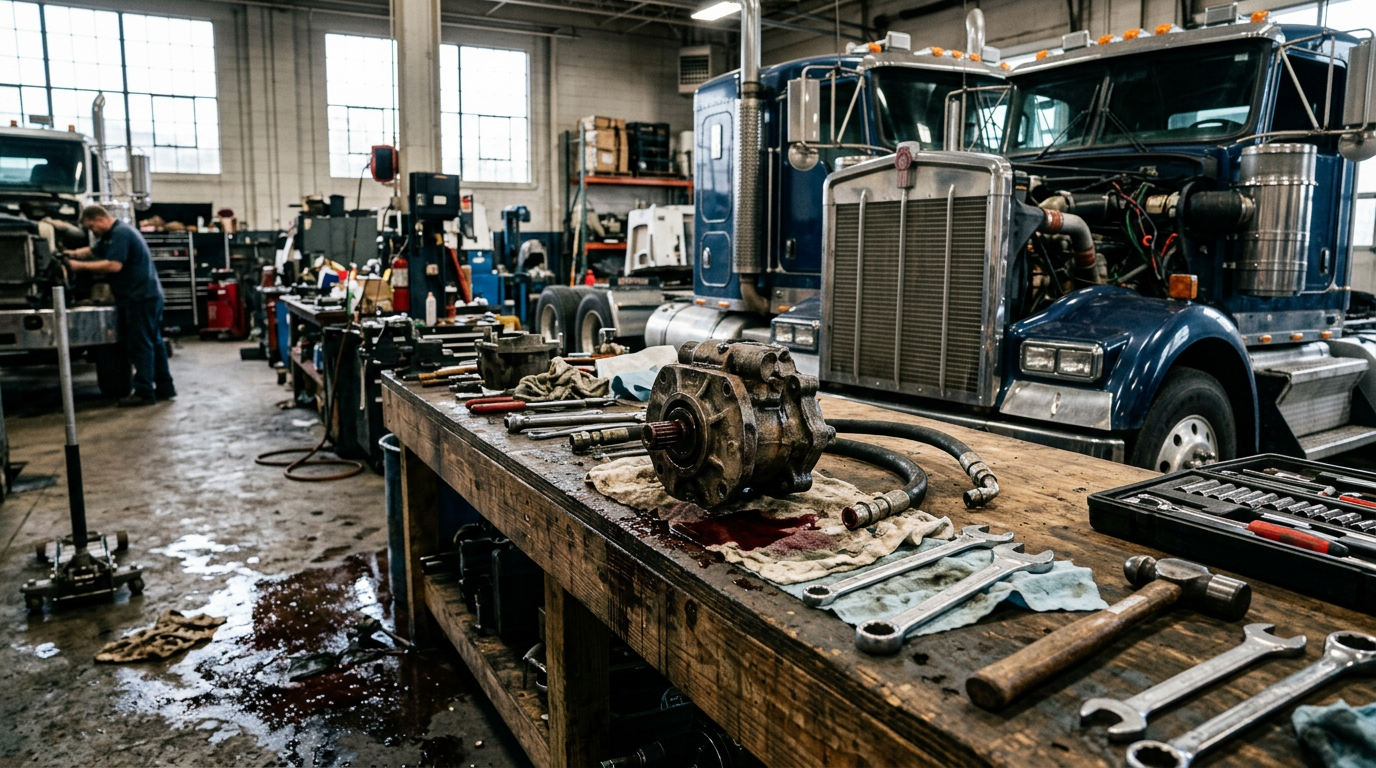
That whine you hear when you crank the wheel at idle isn't normal operation — it's the power steering pump telling you it's running out of patience. Most owner-operators ignore it until the steering gets heavy in a parking lot maneuver or on a tight dock backup, and by then you're looking at a pump that's about to leave you fighting the wheel on the interstate.
The problem is that power steering symptoms overlap. A whining pump, a worn steering gear box, and a collapsed hose can all produce similar complaints — stiff steering, noise, low fluid. Swap the wrong part and you're out parts and labor with the same problem staring back at you.
This guide walks through how to tell a failing power steering pump apart from gear box wear and hose issues, what tests actually confirm pump failure, and when replacement makes more sense than chasing a rebuild on an older Kenworth W900 or similar classic.
The Telltale Whine: What It Means and What It Doesn't
A whining or moaning noise when you turn the wheel — especially at full lock or at idle — is usually the first sign of power steering pump wear. It's typically caused by air in the system, low fluid, or worn internal pump components (vanes, bearings) that can't maintain pressure smoothly.
Before you condemn the pump, check fluid level and look for foam in the reservoir — foam means air is getting in somewhere, often from a loose suction hose or a cracked pickup tube, not necessarily pump failure. Top off, bleed the system per OEM procedure, and re-check.
If the whine persists after a proper bleed and correct fluid level, you're looking at internal pump wear. On a W900 with a lot of hours, this is common after extended service — the pump's bearings and vanes wear down and lose the ability to build consistent pressure, especially noticeable in tight turns like backing into a dock.
Spotting Leaks: Pump, Hose, or Gear Box?
Fluid leaks don't always mean a bad pump. Trace the leak before you order parts.
- Pump seal leaks usually show fluid pooling directly under the pump housing, often with a wet, oily residue around the pulley shaft seal.
- Hose leaks show up along the hose length or at fitting connections — look for wet spots or dried residue trailing down the hose.
- Steering gear box leaks pool near the box itself, usually lower on the frame rail, and often show up with fluid on the pitman arm or drag link area.
Wipe everything down, drive the truck, and recheck. A clean truck makes leaks obvious fast. Don't assume the pump just because fluid's low — a slow gear box leak can drain the reservoir just as easily and get blamed on the pump.
Stiff or Heavy Steering: Isolating the Cause
Hard steering, especially at low speed or during tight maneuvers, points to a pressure problem somewhere in the system — but pinpointing where takes some legwork.
- Check fluid level and condition first — dark, burnt-smelling fluid means the pump's been overheating and probably has internal wear.
- Check belt tension — a slipping belt starves the pump of the RPM it needs to build pressure, mimicking pump failure.
- Check hose condition — a collapsed or kinked hose restricts flow just like a failing pump would.
If fluid's good, belt's tight, and hoses are clear, the stiffness is likely internal pump wear or a worn steering gear box. A pressure test (covered below) separates the two without guesswork.
Pressure Testing the Pump: The Real Diagnostic
Don't guess — test. A power steering pressure gauge kit, installed per OEM procedure, tells you definitively whether the pump is building adequate pressure.
- With the gauge installed and valve open, run the engine and note pressure at idle and at higher RPM.
- Close the valve briefly (per OEM spec, don't hold it longer than specified) to check max relief pressure.
- Compare readings to OEM spec for your pump.
Low pressure with the valve closed confirms internal pump wear — it can't build pressure even when forced to. Good pressure at the pump but stiff steering at the wheel points you toward the steering gear box or linkage instead. This test alone saves a lot of unnecessary pump swaps on trucks like the W900 where gear box wear is just as common as pump failure.
Replacement Intervals and Rebuild vs. Replace
There's no universal mileage interval for power steering pump replacement — it's wear-based, not scheduled, for most fleets. That said, pumps commonly show wear in the 150,000–250,000 mile range depending on duty cycle, fluid maintenance, and belt condition. Trucks running a lot of low-speed maneuvering (dock work, tight yards) tend to wear pumps faster than steady highway miles.
Rebuild kits exist for some pump models, but on high-hour trucks, a quality remanufactured or new pump is often the better call — rebuilding with worn housings and shafts can leave you back in the shop within a few months.
While you're in there, flush the system and replace the fluid — contaminated fluid from a failed pump will kill a new one fast if it's not flushed out first.
Quick answers
Why does my power steering whine when I turn the wheel at idle?
This is almost always low fluid, air in the system, or a worn pump losing internal pressure. Check and top off fluid first, bleed the system, and if the whine continues, the pump likely has internal wear.
Can a bad power steering pump cause hard steering only at low speed?
Yes — pumps build less flow at low RPM, so a weak pump often shows symptoms first during slow maneuvers like dock backing, even when highway steering feels fine.
How do I know if it's the pump or the steering gear box?
A pressure test is the real answer — if the pump builds spec pressure but steering is still stiff, the problem is downstream in the gear box or linkage, not the pump.
How many miles does a power steering pump usually last?
There's no fixed interval, but many pumps show wear somewhere between 150,000 and 250,000 miles depending on duty cycle and fluid maintenance — trucks doing a lot of tight maneuvering wear pumps faster.
Should I rebuild or replace a power steering pump?
On higher-mileage trucks, replacement with a new or quality remanufactured pump is usually more reliable than a rebuild kit on a worn housing. Always flush the system fluid when replacing the pump.
Parts for this job
Real products from the PartsNow catalog. Confirm fitment with Mike before ordering.


Still not sure what's wrong?
Mike — the free AI truck consultant — will walk through your exact symptoms and point you to the right part. No account, English or Spanish, 24/7.
Related truck: Kenworth W900— specs & parts
