Driveshaft & U-Joint Failure: Diagnosing Vibration & Wear
November 5, 2026 · PartsNow Guides
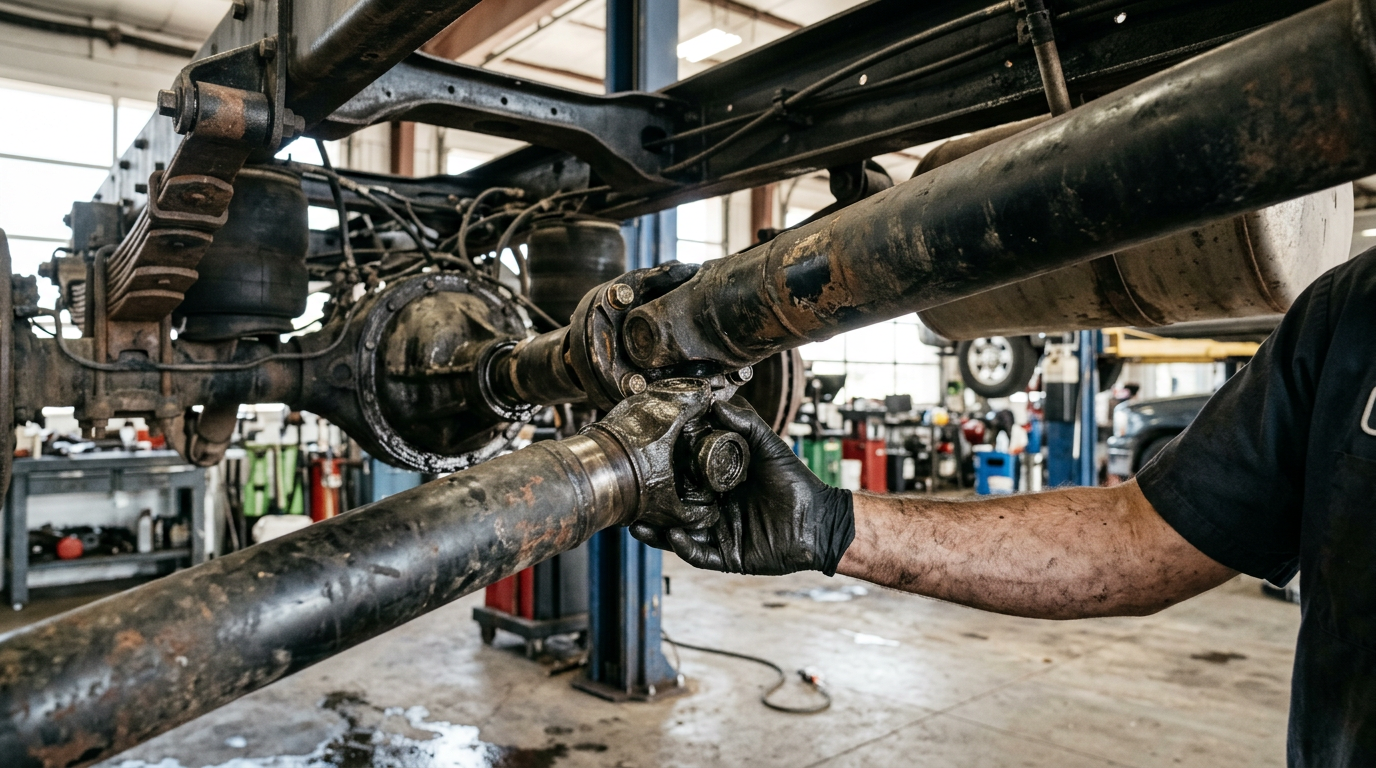
A vibration that shows up at highway speed and disappears when you let off the throttle isn't your imagination — it's your driveline telling you something's loose, worn, or out of balance. Ignore it long enough and a bad U-joint doesn't just rattle your fillings, it can take out your transmission tail housing or your differential pinion seal on the way out.
Most owner-operators notice the clunk on takeoff first — that dead-spot feeling when you go from drive to reverse or hit the throttle hard after coasting. That's classic U-joint slop. By the time you feel it in the seat, the joint's usually past greasing and into replacement territory.
This guide walks through how to find the problem before it finds your transmission, using a Peterbilt 348 with a two-piece driveshaft as our reference point — but the same checks apply whether you're running a single shaft or a multi-piece setup with a center support bearing.
Know the Symptoms Before You Crawl Under the Truck
Three symptoms point to driveline trouble, and they don't always show up together.
- Vibration that changes with speed — gets worse as you accelerate, points to an out-of-balance or bent shaft.
- Clunk on shift from drive to reverse or on hard takeoff — classic worn U-joint with excess play.
- Vibration that changes with load, not speed — often points to a worn center support bearing on multi-piece shafts like you'll find on a Peterbilt 348.
Write down when the vibration happens — at idle, at cruise, under load, on deceleration. That detail saves you an hour under the truck chasing the wrong part. A driveshaft problem at 1,500 RPM feels different than a wheel-end problem at highway speed, and mixing those up wastes diagnostic time you don't have on a working rig.
Don't skip the walk-around. Look for grease flung on the frame rail near the U-joints — that's often the first visible sign a joint is breaking down before you ever feel it in the cab.
The Physical Inspection: Dry Joint Test
With the truck safely blocked and in neutral, this is a two-person or pry-bar job.
- Grab the driveshaft yoke on each side of a U-joint and try to twist it in opposite directions — any play, clicking, or looseness means the joint is shot.
- Check the center support bearing (common on 348s and other two-piece shafts) by pushing up and down on the shaft near the bearing — play here means bearing replacement, not just the joint.
- Inspect the slip yoke/splines for excessive in-and-out movement, which signals spline wear.
- Look at the U-joint caps for rust streaking or dried-up grease — a sign the seal failed and it's running dry.
- Spin the shaft by hand and watch for a bent tube or dented section, especially if the truck's taken a hit from road debris.
If you find play in a joint under load with the engine running, stop — that's not a visual check anymore, that's a drivetrain capable of flinging parts. Get it blocked and keyed off before touching it further.
Grease Intervals: The Cheapest Insurance You Have
U-joints fail from the inside out — the needle bearings dry up long before you see outside wear. Most fleets run on a 12,000 to 25,000-mile grease interval depending on duty cycle, but check your OEM spec for the exact number on your application, since it varies by joint series and manufacturer.
- Grease until you see fresh lube push out all four seals, not just until the gun stops feeling easy.
- If a joint won't take grease at all, that's a dead giveaway it's already failed internally — don't force it, replace it.
- On a Peterbilt 348, don't forget the center support bearing has its own zerk fitting separate from the U-joints — a lot of guys miss it on PM day and it's the first thing to seize.
- Keep a log. Trucks running gravel, construction sites, or heavy off-highway miles need shorter intervals than a dedicated highway tractor.
A five-minute grease job beats a roadside driveshaft drop every time. This is the maintenance item that gets skipped most often because nothing looks wrong — until it is.
Replace vs. Rebuild: Making the Call
Individual U-joint replacement makes sense when the rest of the driveshaft is straight, balanced, and the yokes aren't worn where the joint seats. It's a same-day fix with common parts and gets you back on the road fast.
A full driveshaft rebuild or replacement is the right call when:
- The shaft is bent or dented from road debris or a failed joint that let go
- Yoke ears are worn oversized (joint sits loose even when new)
- Multiple joints are failing on the same shaft — sign of age, not a one-off
- The shaft has never been balanced after a previous repair and vibration persists
On a Peterbilt 348 running a two-piece shaft, don't overlook the center support bearing bracket itself — a cracked or loose bracket will reintroduce vibration even after a perfect joint and bearing swap. Always have the completed shaft dynamically balanced after any rebuild; skipping this step is the most common reason a 'fixed' vibration comes right back.
When This Becomes a Safety Call, Not a Maintenance Call
A U-joint that fails completely at highway speed can drop a driveshaft onto the pavement, and a dropped shaft can wrap around the axle, take out brake lines, or come up through the cab floor. This isn't a 'finish the run and fix it later' item once you've confirmed play in a joint.
- Any driveline work involving the transmission output shaft, differential pinion, or anything that touches steering linkage gets a certified tech's sign-off before the truck goes back in service.
- If you're not 100% sure whether a vibration is driveline or wheel-end related, treat it as a wheel-end/steering safety issue until proven otherwise — that inspection requires a certified tech.
- Never run a truck with a confirmed loose U-joint, even 'just to the yard.' The failure mode is sudden, not gradual.
Document what you found and what you fixed. If a DOT inspector or your safety manager asks, you want a paper trail showing this was caught and corrected, not ignored.
Quick answers
Why does my truck vibrate only at highway speed?
Speed-sensitive vibration almost always points to an out-of-balance or slightly bent driveshaft rather than a worn joint. Have the shaft checked and dynamically balanced — don't just keep replacing U-joints hoping it goes away.
How do I know if it's a U-joint or a wheel bearing?
U-joint problems usually show up as a clunk on shifting or acceleration and can be felt by hand-checking the yoke with the truck off. Wheel bearing issues tend to produce a steady hum that changes with vehicle speed and should be checked by a certified tech since it's a wheel-end safety item.
How often should I grease U-joints on a Class 8 truck?
Most fleets grease every 12,000 to 25,000 miles depending on duty cycle, but check your OEM spec for your specific joint series. Greasing until fresh lube pushes out all four seals is more reliable than going by mileage alone.
Can I replace just one U-joint or do I need the whole driveshaft?
If the shaft is straight and the yoke bores aren't worn oversized, a single joint replacement is fine. If yokes are worn, the shaft is bent, or you've got repeat failures, it's time for a full rebuild and balance.
Is a clunking noise on takeoff always a U-joint problem?
It's the most common cause, but worn transmission or differential mounts and loose pinion yokes can cause similar clunks. A hands-on inspection of the joints and mounts with the truck blocked and keyed off is the only way to know for sure.
Parts for this job
Real products from the PartsNow catalog. Confirm fitment with Mike before ordering.


Still not sure what's wrong?
Mike — the free AI truck consultant — will walk through your exact symptoms and point you to the right part. No account, English or Spanish, 24/7.
Related truck: Peterbilt 348— specs & parts
