Fuel Filter & Water Separator: When to Change and Why
July 26, 2026 · PartsNow Guides
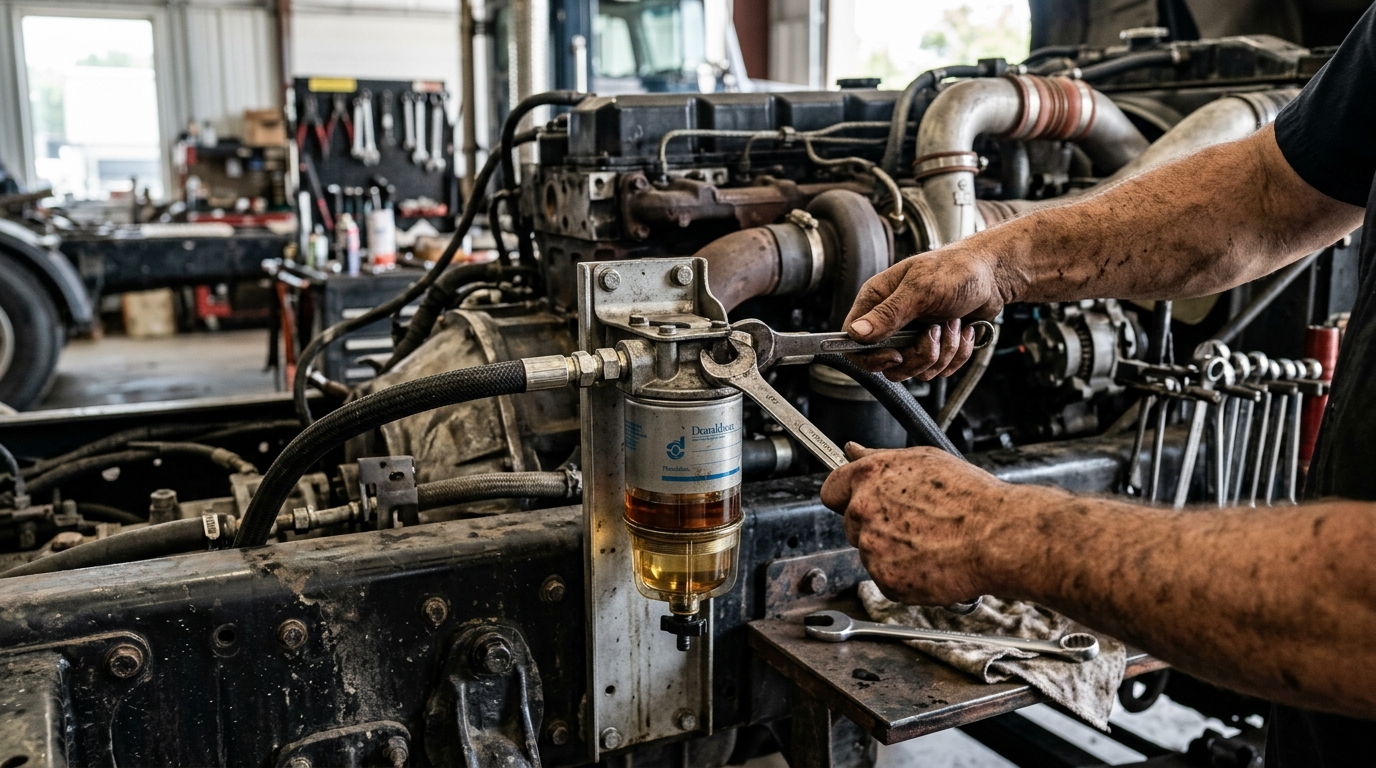
You're pulling a grade outside Laramie and the truck starts stumbling like it's running out of gas. It is — sort of. A clogged fuel filter or a water separator full past its float can starve your injection pump right when you need every horse you've got. By the time you feel that power loss, you're usually already past the point of cheap fixes.
Fuel filtration doesn't get the attention brakes and tires do, but it's just as critical to keeping a truck on the road. Modern common-rail systems on rigs like the Volvo VNR run injection pressures north of 25,000 PSI — a speck of dirt or a slug of water in that system doesn't just cause a hard start, it can take out a $2,000+ injector in one bad run. This guide covers what to watch for, how to service your primary and secondary filters and water separator, and how to decide between OEM and aftermarket filtration.
Symptoms of a Clogged Fuel Filter
A dirty fuel filter doesn't fail all at once — it chokes down gradually, and most drivers write off the early signs as "the truck just feels tired." Don't ignore these:
- Power loss under load, especially climbing grades or pulling away from a stop
- Hard starting, particularly cold mornings when fuel is thicker and harder to pull through a restricted element
- Rough idle or surging at steady RPM
- Stalling when fuel demand spikes
- Increased black or white smoke as the ECM compensates for inconsistent fuel delivery
On a VNR with the D13, a clogged primary filter will often throw a fuel pressure or rail pressure fault code before you notice it in the seat of your pants — check the fault log, don't just wait to feel it. If you're seeing these symptoms and the filters were changed recently, don't assume they're clean. A bad batch or a tank with sediment stirred up can clog a brand-new filter in a few hundred miles.
Primary vs Secondary Filters: What Each One Does
Most modern diesels, including the VNR, run a two-stage filtration setup, and each stage has a job:
- The primary fuel filter (often combined with the water separator) sits between the tank and the fuel pump. It catches larger particulate and knocks water out of the fuel before it reaches anything expensive.
- The secondary fuel filter sits downstream, usually right before the high-pressure pump or rail. It's a finer micron rating — this is your last line of defense protecting injectors.
Here's the part techs miss: changing only one filter and leaving the other is a half-job. If your primary is clogged and restricting flow, your secondary is starving too, and vice versa. When you service one, service both — they're cheap insurance next to injector replacement costs. Always follow OEM spec for micron ratings; mixing a coarser secondary filter than spec'd defeats the purpose of the two-stage system entirely.
Water Separator: The Silent Injector Killer
Water in diesel fuel is worse than dirt. It doesn't lubricate, it corrodes injector tips, and under high-pressure injection it can cause cavitation damage inside the pump and rail — damage that shows up as pitting and premature failure, sometimes thousands of miles down the road with no obvious cause.
Most water separators use a clear bowl or a sight glass with a float — check it daily during your pre-trip if you're running in humid climates, biodiesel blends, or fueling at stations with older underground tanks (more prone to condensation and water intrusion).
Warning signs of water in fuel:
- Sputtering or stalling that seems to come and go, especially after fueling
- Milky or cloudy diesel in a clear sight bowl
- Rust-colored sediment in the drained sample
- Repeated fuel filter clogging shortly after service
Drain the separator per OEM interval, or immediately if you see water in the bowl — don't wait for the scheduled service. On a VNR, the drain valve is easy to access and takes two minutes; there's no excuse to skip it.
Service Intervals: How Often Should You Change Fuel Filters
There's no universal mileage number that works for every truck and every fuel source — follow per OEM spec for your specific engine and duty cycle. Volvo's maintenance schedule for the VNR gives specific intervals based on the D11/D13 engine and your operation type (severe duty vs standard highway), and that schedule accounts for things like idle time and fuel quality assumptions.
That said, here's the practical reality from the shop floor:
- If you're running rough fuel sources, biodiesel blends above B5, or older stations regularly, cut the interval shorter than the standard recommendation
- Watch your fuel pressure readings on the dash or through diagnostic software — a downward trend means the filter's loading up before the mileage interval hits
- Always change filters after any major fuel contamination event (bad load of fuel, tank sediment disturbed by low fuel levels) regardless of when the last change was
When in doubt, check your DTCs and fuel pressure trends rather than relying purely on the odometer.
OEM vs Aftermarket Filters: Making the Call
This is where shops split into two camps, and both have a point.
OEM filters are built to the exact micron rating and flow spec the engine was designed around. For a VNR running a common-rail D13, that precision matters — undersized filtration lets particulate through that can score injector tips over time. If you're still under warranty, using OEM (or an approved equivalent) keeps you covered and avoids any argument with the dealer over a claim.
Aftermarket filters from reputable manufacturers can match OEM spec at a lower cost, and for older trucks out of warranty, that's often the smarter buy. The catch is quality control varies a lot more in the aftermarket space — a filter that's technically rated right but built with cheaper media or a weaker seal can fail early or let contaminants through under vibration.
Bottom line: don't shop on price alone. Check the micron rating matches OEM spec, buy from a supplier you trust, and if you're under warranty, confirm the part won't create a coverage issue before you install it.
Quick answers
How often should I change my fuel filter on a Volvo VNR?
Follow Volvo's maintenance schedule per OEM spec for your D11 or D13 engine and duty cycle — severe duty operations need shorter intervals than standard highway use. Also watch fuel pressure trends and fault codes between scheduled changes; a filter loading up early will show there before you feel it in the cab.
Can a clogged fuel filter damage my injectors?
Yes — a clogged filter causes fuel starvation and pressure irregularities that force the injection system to work outside its designed parameters, and any contaminant that gets past a failing filter can score injector tips directly. On high-pressure common-rail systems, that damage adds up fast and injectors aren't cheap to replace.
How do I know if there's water in my fuel?
Check your water separator's sight glass or bowl regularly — cloudy or milky fuel, visible water pooling at the bottom, or rust-colored sediment are all red flags. Sputtering or stalling shortly after fueling is another sign; drain the separator immediately rather than waiting for the next scheduled service.
Parts for this job
Real products from the PartsNow catalog. Confirm fitment with Mike before ordering.

FS19765FLG
FS19765FLG - FUEL FILTER SEPARATOR
$32.95

23530645
23530645 - FUEL ELEMENT FILTER
$63.31

K37-1029
K37-1029 - FUEL FILTER ELEMENT
$66.14

2234788PE
2234788PE - OIL FILTER ELEMENT
$58.84

LF3313
LF3313 - OIL FILTER LF3313
$7.50

243009
243009 - AIR COMPRESSOR FILTER
$20.63

P621725
P621725 - AIR CLEANER FILTER
$273.82

W2084001
W2084001 - REC IRC AIR FILTER
$36.92
Still not sure what's wrong?
Mike — the free AI truck consultant — will walk through your exact symptoms and point you to the right part. No account, English or Spanish, 24/7.
Related truck: Volvo Trucks VNR— specs & parts
