Driveline Vibration: U-Joints, Yokes & Balance Diagnosis
July 29, 2026 · PartsNow Guides
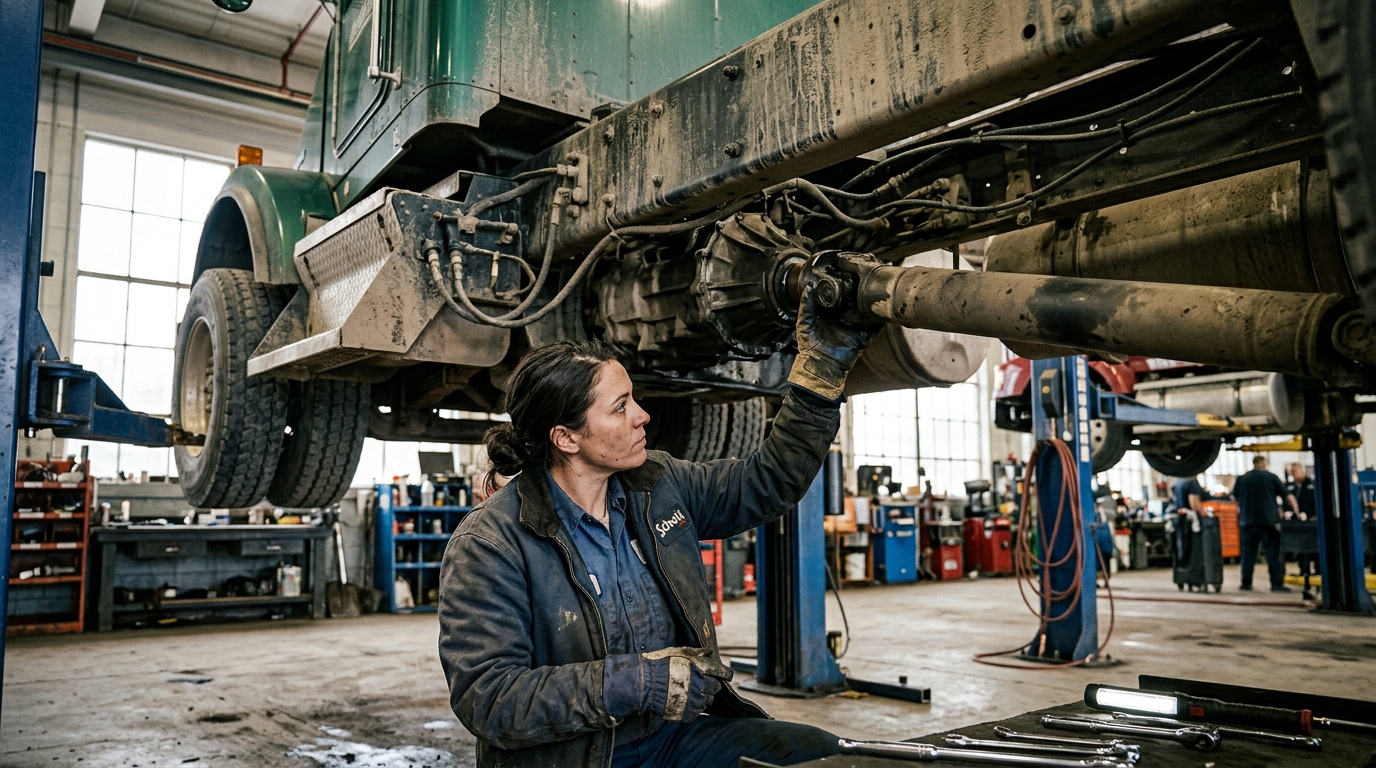
You feel it first in the seat of your pants — a buzz that shows up right around 45 mph and either fades or gets meaner as you climb through the gears. Drivers call it "the shake." Left alone, that shake isn't just annoying, it's beating the fool out of your transmission's rear seal, your pinion seal, and every U-joint in the line. By the time it's loud enough to hear over the engine, you're usually looking at parts damage, not just parts wear.
Driveline vibration has three usual suspects: worn U-joints, a bent or twisted yoke, or a driveshaft that's lost its balance from a bent tube, missing balance weight, or built-up road debris. Each one shakes differently and shows up at different speeds, which is your first clue. This guide walks through how to isolate the source on a Class 8 tractor — we'll use a Kenworth T800 as our reference truck — before you start throwing parts at it.
Don't guess on this one. A driveshaft coming apart at highway speed can take out fuel lines, wiring, even the cab floor. Diagnose it right, and if the fix touches steering or wheel-end components, get a certified tech to sign off before the truck goes back on the road.
Know the Symptom Signature Before You Touch a Wrench
Vibration diagnosis starts with your ears and your seat, not a wrench. Speed-sensitive vibration that comes and goes at a specific RPM range usually points to driveline imbalance or a bad U-joint — it's tied to shaft rotation speed, not engine load. Load-sensitive vibration that changes when you're pulling a grade versus coasting often points to a worn joint binding under torque, or a yoke that's walked loose.
On a T800 with a standard two-piece driveshaft setup, note whether the shake is in the cab, the frame, or felt through the pedals. Cab-only vibration can be motor mounts fooling you into a driveline hunt — rule that out first by feeling the frame rail near the transmission crossmember with the truck idling in gear.
- Write down the speed where it starts and where it peaks
- Note if it's worse in a straight line vs. through the reduction gears
- Check if it changes when you're on the brakes lightly (rules out wheel-end imbalance)
This info saves you hours once you're under the truck.
Inspect Every U-Joint by Hand — Don't Trust Your Eyes Alone
A worn U-joint rarely looks bad until it's nearly done. Eyeballing it from the ground will miss the early wear that's already causing your shake.
- With the truck safely blocked and in neutral, grab each yoke on both sides of every joint and try to rock it — any play, clunk, or looseness means the joint's done
- Check for rust-colored dust ("bleeding") around the joint caps — that's a sign the seals have failed and grease is gone
- Rotate the shaft by hand and feel for rough spots, binding, or grinding through the joint's full rotation
- Look at the grease fitting — if it's been skipped on PM intervals, that joint's wear clock ran faster than it should have
On a T800 with a mid-ship bearing, don't forget to check that carrier bearing too — a worn center bearing mimics U-joint symptoms and gets missed constantly because techs go straight for the joints and stop looking.
Any play at all means replacement — there's no "tightening up" a worn U-joint.
Check Yoke Alignment and Phasing
A bent or twisted yoke will vibrate even with brand new U-joints installed, so this step gets skipped too often and it costs guys a comeback.
Yokes need to stay in phase — meaning the ears on both ends of the shaft line up on the same plane. If a yoke got knocked out of phase during a joint replacement or from a driveline drop, you'll get a vibration that looks exactly like a bad joint but new parts won't fix it.
- Check yoke lugs for elongation or wear where the U-joint strap bolts seat — this is a common source of driveline noise that's mistaken for joint wear
- Verify the slip yoke slides freely in the transmission output without binding or excess play
- Inspect for any visible bend or twist, especially after a driveline has dropped from a failed joint
- Confirm strap bolts or U-bolts are torqued to OEM spec — under-torque here causes movement that reads like imbalance
If a yoke's bent, replace it. Don't try to straighten it and put it back in service — that's a shortcut that comes back to bite you on the highway.
Balancing the Driveshaft on a Class 8 Tractor
If joints and yokes check out clean and the vibration's still there, you're likely looking at an imbalanced driveshaft — from a bent tube, a lost balance weight, built-up mud/road grime, or shaft runout from a hard hit.
- Clean the shaft completely before you assume it's out of balance — packed mud or ice on one side of the tube throws balance just like a manufacturing defect
- Check for visible dents or bends along the tube — even minor damage changes rotating mass distribution
- Measure runout with a dial indicator if you've got one and the shaft is out of the truck — per OEM spec for allowable runout, anything beyond that needs shop balancing or replacement
- If the shaft's straight and clean but still shakes, it needs to go to a driveline shop with a balancing machine — this isn't a roadside fix
Don't reuse a driveshaft that's taken a hard impact without having it checked, even if it spins fine by hand. Bent tubes don't always show up until they're spinning at highway RPM.
When to Stop Guessing and Pull the Shaft
If you've checked joints, yokes, and cleaned/inspected the shaft and the vibration's still a mystery, pull the driveshaft and have the truck driven (carefully, at low speed) to isolate whether the vibration's still there without it. This tells you definitively whether you're chasing a driveline issue or something else — wheel-end imbalance, a bad clutch, or a transmission internal problem masquerading as a driveline shake.
This is also the point where you stop throwing parts at a truck hoping something sticks. A shop with a proper balancing setup can true up a shaft that's otherwise structurally sound, saving you the cost of a full replacement.
Any work involving wheel-end components, steering linkage, or suspension mounts uncovered during this diagnosis needs a certified tech's sign-off before the truck's back in service — driveline vibration diagnosis can lead you into steering and suspension territory fast, and those aren't areas for shortcuts.
Quick answers
Can a bad U-joint damage my transmission if I keep driving on it?
Yes — a worn joint sends vibration straight back into the transmission's output shaft and rear seal, and over time that beats the seal loose and causes a fluid leak. Catching it early with the hand-check method saves you a much bigger repair bill later.
Why does my truck vibrate only at highway speed but not around town?
That's the classic signature of driveline imbalance or a worn U-joint, since both are tied to rotational speed rather than load. If it changed with grade or pulling weight instead, you'd be looking more at a joint binding under torque.
Can I balance a driveshaft myself in my shop?
You can inspect, clean, and check runout yourself, but true dynamic balancing needs a specialized machine that most owner-operator shops don't have. Once you've ruled out joints, yokes, and obvious damage, take the shaft to a driveline specialist for balancing.
Parts for this job
Real products from the PartsNow catalog. Confirm fitment with Mike before ordering.


Still not sure what's wrong?
Mike — the free AI truck consultant — will walk through your exact symptoms and point you to the right part. No account, English or Spanish, 24/7.
Related truck: Kenworth T800— specs & parts
