DPF Clogged? Diesel Particulate Filter Symptoms & Fixes
July 15, 2026 · PartsNow Guides
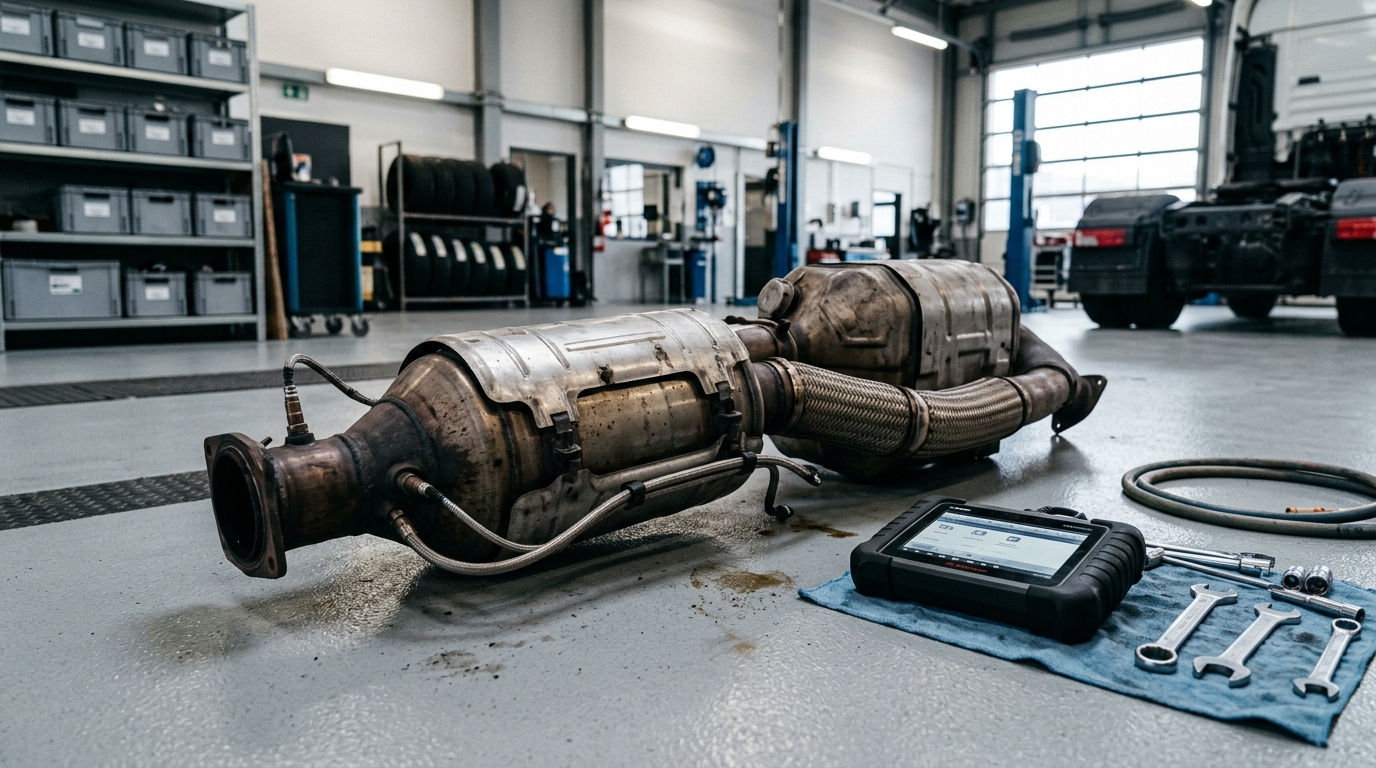
If your truck's been feeling gutless, guzzling more fuel than usual, or throwing you into regen every time you turn around, don't just blame "the emissions stuff" and keep driving. Your diesel particulate filter (DPF) is telling you something, and if you ignore it long enough, it'll tell your truck to shut down on the side of the road in a full derate.
I've seen owner-operators limp a Mack Pinnacle into the shop at 15 mph because they kept clearing codes instead of dealing with the root problem. By the time it gets to that point, you're not looking at a quick fix — you're looking at a filter swap, a DPF cleaning bill, or worse, a cooked turbo from running too hot too long trying to force a regen that wasn't going to take.
This guide walks through the real-world symptoms of a clogging DPF, what's actually happening inside that filter, and the fixes — from a simple forced regen to pulling the filter for cleaning or replacement. Anchor this to your own truck's fault codes and dash warnings, but the pattern holds across most modern diesels.
What the DPF Actually Does (and Why It Clogs)
The DPF traps soot particles from exhaust so they don't go straight into the air. Over time that soot builds up inside the filter's honeycomb structure. Normal operation burns it off through regen cycles — either passive (highway heat does the work) or active (the ECM injects extra fuel to spike exhaust temps).
Problems start when soot builds up faster than regen can clear it. Short-haul routes, lots of idle time, or a truck that never gets up to highway speed are the usual suspects — the Mack Pinnacle running local delivery routes is a textbook case. Bad fuel, a failing EGR valve, or a leaking injector dumping unburned fuel into the exhaust can also load up the filter faster than it should.
Once ash and soot pack in tight enough, you're not just losing performance — you're building backpressure that can damage the turbo and engine over time if it's not addressed.
Early Symptoms: Power Loss and Excess Regens
The first signs are subtle. You'll notice:
- Sluggish acceleration or the truck feels like it's working harder to hold speed
- Fuel economy dropping noticeably over a few weeks
- Regen cycles happening more often than normal — daily instead of every few days
- A DPF lamp lit steady on the dash, not flashing
On a Mack Pinnacle, this usually shows up first as the driver complaining the truck "just doesn't pull like it used to" going up grades. Check the dash for the soot load percentage if your instrument cluster shows it — most modern trucks display this in a menu. Anything consistently climbing above the manufacturer's threshold before a regen kicks off means the filter's falling behind.
Don't ignore this stage. This is the cheap window to fix it — before it escalates to a derate.
Red Flag Symptoms: Derate and Warning Escalation
If you've blown past the early warnings, expect the ECM to start protecting itself:
- Flashing DPF lamp — regen is needed now, not later
- Check engine light paired with a derate warning — speed capped, often around 30-45 mph depending on the OEM setting
- Reduced power / limp mode — the truck won't pull past a certain RPM or throttle position
- Stop engine light — this means shut down safely, don't push it further
On the Pinnacle, once you hit derate, the dash will typically show a specific fault code alongside the warning — write it down before you clear anything, your tech will need it. Running the truck hard in this state risks damaging the DPF substrate or the turbo from excess backpressure. Get it to a shop or a safe spot to attempt a fix before continuing.
Fix #1: Forced Regen (Parked Regen)
If the truck's still driveable and the soot load isn't extreme, a forced regen (also called parked or stationary regen) is your first move. This is a technician- or driver-initiated cycle that runs at a controlled idle with the ECM dumping extra fuel to spike exhaust temps and burn off soot — no highway driving required.
Steps, generally:
- Park the truck in a well-ventilated area, away from anything flammable — exhaust temps get extremely hot
- Set the parking brake, put it in neutral
- Access the regen switch or menu (varies by OEM — check your Pinnacle's dash controls or service manual)
- Initiate the cycle and let it run to completion, typically 20-45 minutes
- Don't shut it down early — an interrupted regen can leave the filter half-cleaned and cause repeat issues
If a forced regen won't complete or the derate doesn't clear, you're past what a regen alone can fix — move to filter service.
Fix #2: DPF Cleaning or Replacement
When regen won't clear the problem, the filter itself needs attention. Soot burns off with regen, but ash — the mineral residue from oil additives — doesn't. Ash builds up permanently and eventually chokes the filter regardless of how many regens you run.
Options:
- Professional DPF cleaning — the filter gets pulled and cleaned with specialized equipment (thermal or pneumatic cleaning) that removes ash buildup a regen can't touch. This is the standard fix at most intervals per OEM spec.
- Filter replacement — if the substrate is cracked, melted, or the filter's been cleaned past its service life, it needs to be replaced outright.
- Root cause check — before you button it back up, check the EGR valve, injectors, and turbo for issues that caused excess soot loading in the first place. Fixing the filter without fixing the cause just buys you a repeat trip.
This is standard maintenance work, not safety-critical, but get the backpressure sensor and exhaust connections checked for leaks while it's apart.
Quick answers
Can I keep driving with the DPF light on?
If it's a steady light, yes — for now, but get a regen done soon. If it's flashing or paired with a derate warning, get it addressed immediately before it escalates to a full shutdown.
How often should a DPF be cleaned on a Mack Pinnacle?
It depends on duty cycle and mileage — check your Pinnacle's maintenance schedule for the recommended interval per OEM spec. Trucks running lots of idle or short-haul routes typically need it sooner than long-haul highway trucks.
Why does my truck keep going into regen so often?
Frequent regens usually mean something upstream is loading the filter faster than normal — check for EGR valve issues, injector problems, or a driving pattern with too much idle and not enough sustained highway speed to let passive regen do its job.
Parts for this job
Real products from the PartsNow catalog. Confirm fitment with Mike before ordering.

2234788PE
2234788PE - OIL FILTER ELEMENT
$58.84

LF3313
LF3313 - OIL FILTER LF3313
$7.50

FS19765FLG
FS19765FLG - FUEL FILTER SEPARATOR
$32.95

23530645
23530645 - FUEL ELEMENT FILTER
$63.31

K37-1029
K37-1029 - FUEL FILTER ELEMENT
$66.14

243009
243009 - AIR COMPRESSOR FILTER
$20.63

P621725
P621725 - AIR CLEANER FILTER
$273.82

W2084001
W2084001 - REC IRC AIR FILTER
$36.92
Still not sure what's wrong?
Mike — the free AI truck consultant — will walk through your exact symptoms and point you to the right part. No account, English or Spanish, 24/7.
Related truck: Mack Trucks Pinnacle— specs & parts
