Air Dryer Failure: Diagnosing Moisture & Freeze-Up Issues
August 8, 2026 · PartsNow Guides
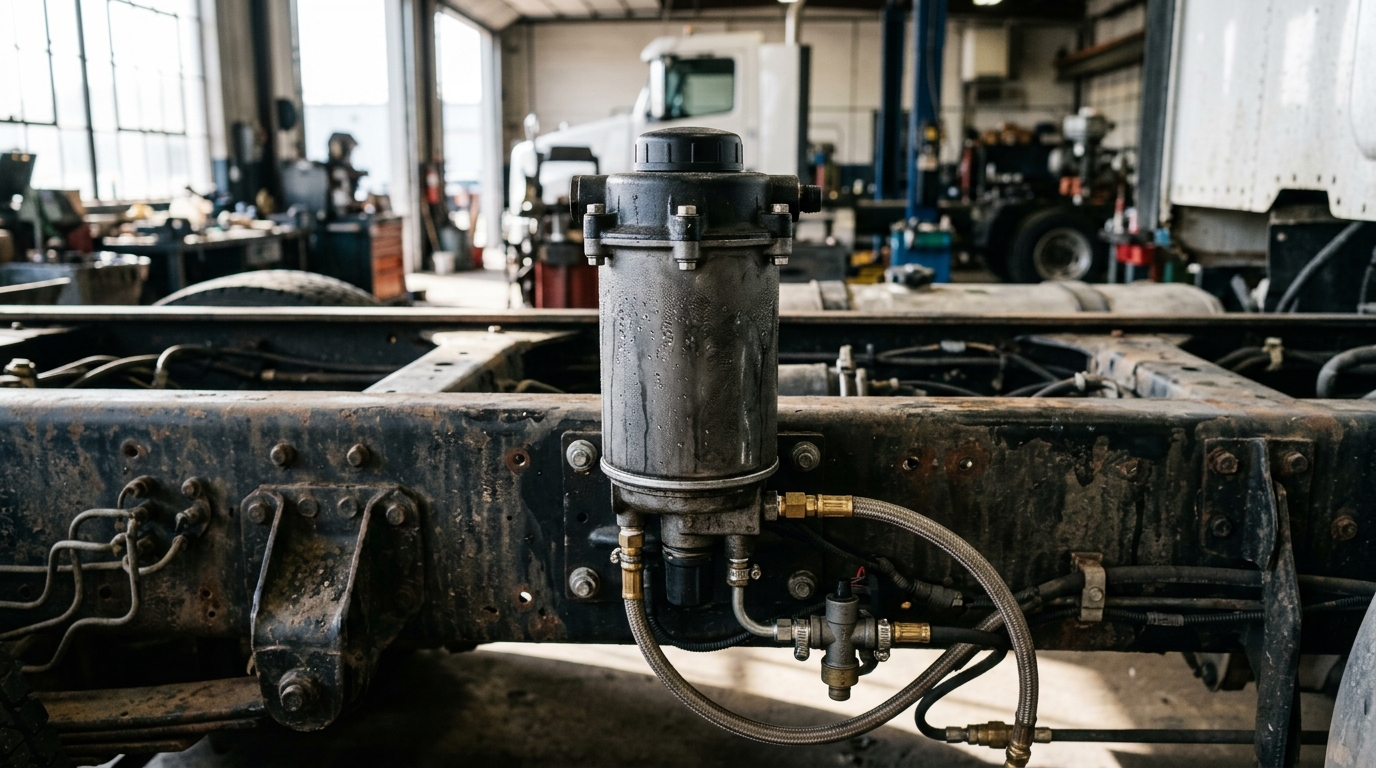
First cold morning of the season, and half your fleet is sitting with frozen air lines or brakes that release like they're wading through mud. Nine times out of ten, that's your air dryer telling you it quit doing its job months ago — you just didn't notice until the mercury dropped.
Air dryers don't fail all at once. They fail slow — a little water in the tanks here, a sluggish purge cycle there — until one January night the whole truck won't move. By the time you're chaining open a frozen service line at 5 AM in a truck stop lot, you're way past the cheap fix.
This guide walks through the checks we run in the shop to find out whether you're looking at a bad desiccant cartridge, a dead heater, a stuck purge valve, or just a dryer that's earned its retirement. We'll use the Peterbilt 387 as our reference truck since its dryer setup is common across a lot of Class 8 fleets, but the diagnostic logic holds regardless of make.
How to Spot a Failing Air Dryer Before It Strands You
Don't wait for a frozen line to tell you something's wrong. Check these signs during your pre-trip or PM:
- Purge valve exhaust — should be a short, sharp blast of air, not a weak hiss or a long drawn-out leak
- Moisture at the air tank drain cocks — pull the tanks weekly; any water (especially before winter) means the dryer isn't keeping up
- Slow brake release — if the brakes seem to "hang" for a second before releasing, moisture or oil contamination in the system is a likely culprit
- Oily residue on the dryer housing or in the purge exhaust — points to a failing air compressor pushing oil carryover into the desiccant bed
- Frost or ice on the dryer body itself in cold weather, even when ambient temps aren't extreme
On a 387, the dryer sits low on the frame rail behind the front axle — road grime and salt eat at the wiring and heater connections there faster than people expect. Check those connectors are clean and seated before you assume the heater element itself is bad.
Desiccant Cartridge: When It's Saturated, Not Just Old
The desiccant cartridge is the heart of the dryer — it's the bead-filled canister that actually pulls moisture out of the compressed air. These beads have a finite capacity, and once they're saturated or physically broken down, they stop absorbing water no matter how good the rest of the dryer is.
To check it:
- Pull tank samples after a full duty cycle — if you're getting consistent moisture even after replacing the cartridge, look elsewhere (compressor oil carryover, bad purge timing)
- Inspect the cartridge for bead dust or a rattling sound when shaken — broken-down desiccant means it's done
- Note your last cartridge swap — most fleets run these on a mileage or time interval per OEM spec, not "until it fails"
Cartridges are a wear item, not a diagnostic dead-end. If you're replacing them more often than spec calls for, the real problem is upstream — usually compressor oil contamination cooking the beads early.
Heater and Thermostat Failures: The Freeze-Up Culprit
Most freeze-up complaints trace back to a dead heater element or failed thermostat inside the dryer housing. The heater's whole job is keeping the purge valve and surrounding components warm enough that condensation doesn't turn to ice and jam things up.
How to check it:
- With the truck running and ambient temps below 40°F, feel the dryer housing near the heater — it should be warm to the touch within a few minutes
- Use a multimeter to check for continuity across the heater element and thermostat — no continuity means a dead part
- Check the wiring harness and connector for corrosion — this is the most common failure point on trucks that run winter routes, including 387s that see a lot of Midwest and Northeast salt exposure
- Verify the dash indicator or heater relay is actually energizing — a good heater with no power reaching it looks identical to a dead heater from the driver's seat
A heater failure doesn't always throw a fault code, so don't rule it out just because nothing lit up on the dash.
Purge Valve Problems: Slow Release and Constant Cycling
The purge valve dumps accumulated moisture and contaminants out of the dryer every time the compressor unloads. When it fails, you'll see one of two patterns — it sticks open (constant air loss, compressor never catches up) or sticks closed (no purge at all, moisture just builds up in the tanks).
Diagnostic steps:
- Listen for the purge cycle during a governor cutout — you should hear one clean exhaust pulse, not continuous leakage or silence
- Check the purge valve diaphragm for cracking or hardening if you pull it apart — rubber components age out even without visible failure
- Confirm the control line (or electronic signal on newer dryers) is actually reaching the valve — a good valve with no signal behaves like a bad one
- Watch build-up time from low to cutout — if it's noticeably longer than spec, a leaking purge valve is a common cause
A slow brake release complaint almost always traces back here or to the desiccant, not the brake chambers themselves — don't let a shop jump straight to brake work without ruling out the dryer first.
Rebuild vs. Replace: Making the Call
Here's how we make the call in the shop:
- Rebuild if the housing, valve body, and electrical components are sound and you're only replacing the desiccant cartridge, purge valve kit, or a heater element — rebuild kits are cheaper and get you back on the road fast
- Replace if you're seeing repeated failures on the same unit, corrosion in the housing itself, or a heater/thermostat failure on a dryer that's already had two or more other repairs
- Replace if the unit is out of production or parts are hard to source — chasing rebuild kits for an obsolete dryer costs more in downtime than a new unit costs in parts
For a fleet running 387s hard through winter routes, a lot of shops standardize on full dryer replacement at a set mileage interval rather than nickel-and-diming rebuilds — it's more predictable for budgeting and keeps you off the shoulder in a January freeze. Either way, this is straightforward air system maintenance, not a safety-certification item on its own — but if a dryer failure has already caused a slow brake release, get the brake system itself inspected by a certified tech before returning the truck to service.
Quick answers
Why does my truck's air system freeze up even with a working air dryer?
A working dryer can still freeze up if the heater element or thermostat has failed, since that's what keeps the purge valve area above freezing. Also check for oil carryover from the compressor — it can saturate the desiccant faster than expected and let moisture back into the lines.
How often should I replace the desiccant cartridge?
Follow the mileage or time interval per OEM spec for your dryer model, not just when you notice moisture. If you're needing early replacements consistently, look at your compressor for oil contamination before blaming the cartridge.
Can a bad air dryer cause slow brake release?
Yes — moisture and oil contamination in the air system from a failing dryer is one of the most common causes of sluggish brake release. Rule out the dryer and desiccant condition before assuming it's a brake chamber or valve issue, and have a certified tech inspect the brake system itself if the problem persists.
Parts for this job
Real products from the PartsNow catalog. Confirm fitment with Mike before ordering.


Still not sure what's wrong?
Mike — the free AI truck consultant — will walk through your exact symptoms and point you to the right part. No account, English or Spanish, 24/7.
Related truck: Peterbilt 387— specs & parts
