Turbocharger Failure: Symptoms, Smoke & Power Loss Diagnosis
September 24, 2026 · PartsNow Guides
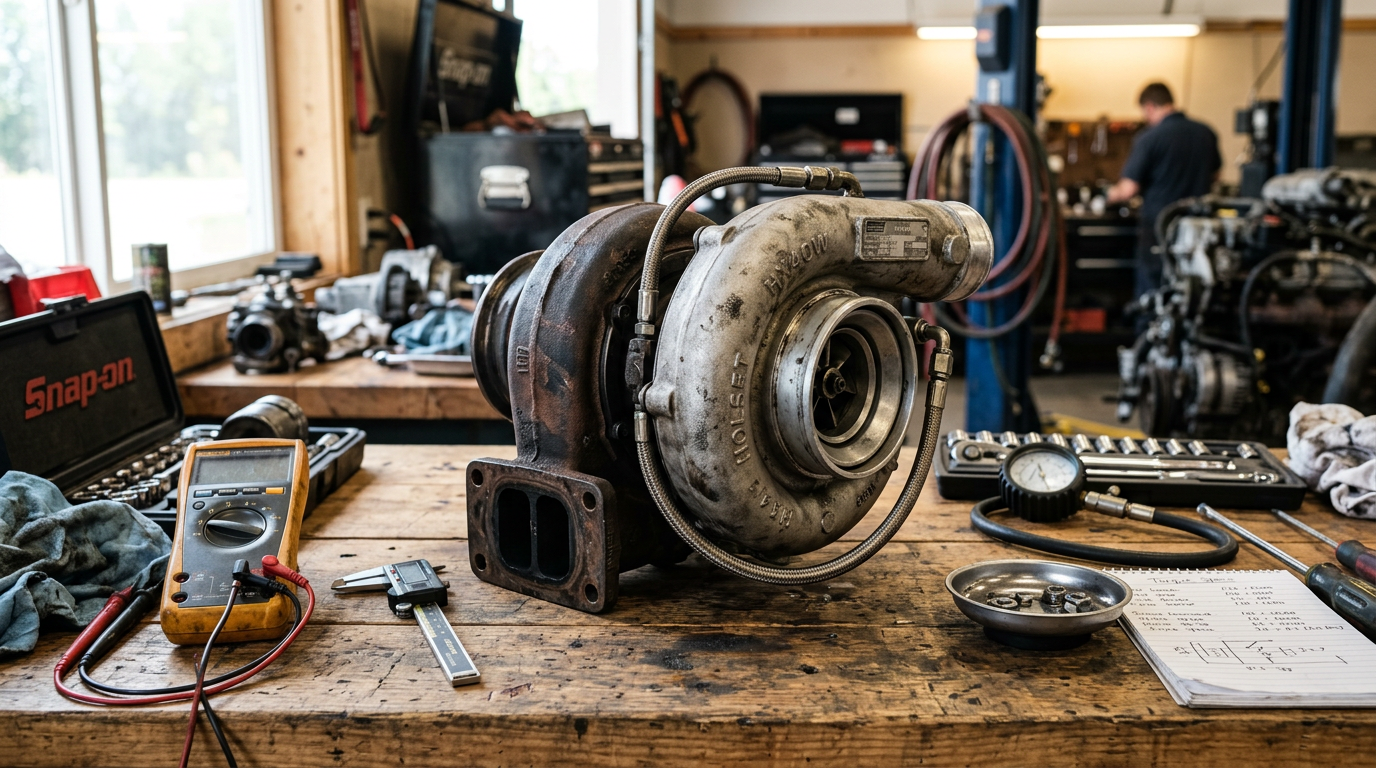
A dying turbo doesn't usually quit all at once. It gives you weeks of warning signs first—a whine that creeps into the cab, blue-gray smoke on startup, boost numbers that don't add up anymore. Most guys ignore it because the truck still pulls, right up until the day it doesn't, or worse, until metal shavings from a seized turbo get pulled straight into the cylinders.
We've torn into enough Peterbilt 387s running the C15 and ISX to know the pattern. Turbo failure rarely happens in a vacuum—it's fed by oil starvation, contaminated fuel, boost leaks the driver's been living with for months, or a failing wastegate actuator nobody bothered to check. Catch it in the whine-and-smoke stage and you're looking at a turbo swap. Catch it after the bearings let go and send debris downstream, and you're looking at a rebuild or worse.
This guide walks through what to listen for, what to look for, and how to tell the difference between a turbo that needs replacing and one that's just showing its age.
The Early Warning Signs You Shouldn't Ignore
Bearing whine is usually the first tell. It starts as a high-pitched sound under acceleration, often mistaken for a belt or alternator issue. If it changes pitch with engine RPM specifically—not vehicle speed—that's your turbo shaft bearings wearing out.
Oil smoke on startup or during deceleration means oil is getting past the seals into the exhaust or intake side. Blue-gray smoke at idle after a hard pull is a classic sign the turbo seals are shot.
Power loss shows up as sluggish acceleration, especially climbing grades—something a 387 running an ISX shouldn't struggle with if the turbo's healthy. Check your boost gauge if you've got one; a drop from normal operating boost is a red flag.
Excess exhaust smoke under load, particularly black smoke that used to be lighter, can mean the turbo isn't spinning fast enough to deliver adequate air-to-fuel ratio.
Don't wait on any of these. A turbo in early failure gives you a window—use it before it closes.
Checking for Shaft Play and Boost Leaks
With the engine off and intake/exhaust piping disconnected from the turbo, grab the compressor wheel and try to move it side to side and in-and-out. Some play is normal per OEM spec, but excessive axial or radial movement means the bearings are worn out. If the wheel drags or you feel grinding, that turbo's done.
Spin the wheel by hand—it should turn freely with no scraping. Any contact between the wheel and housing means it's already eaten into itself.
For boost leaks, do a pressure test on the entire charge air system—clamps, couplings, the charge air cooler, and the turbo outlet. A leak downstream of the turbo makes the turbo work harder to compensate, which accelerates wear even if the turbo itself started out healthy. On a 387, check the boots behind the cab first—they take a beating from vibration and heat cycling.
Inspect for oil residue at the compressor inlet or turbine outlet. Oil where it shouldn't be confirms seal failure, not just a leak issue.
What's Actually Failing Inside the Turbo
Most turbo failures trace back to one of a few root causes, and knowing which one you're dealing with tells you whether it's a turbo problem or a bigger problem.
- Oil starvation — low oil pressure or a clogged feed line kills bearings fast. Check the feed and drain lines before you blame the turbo itself.
- Oil contamination — dirty oil or extended service intervals introduce abrasive particles that chew up bearing surfaces.
- Foreign object damage (FOD) — a cracked intake hose or missing air filter lets debris into the compressor wheel, bending or breaking blades.
- Wastegate/actuator failure — a stuck wastegate causes overboost or underboost conditions that stress the whole assembly.
- Thermal fatigue — repeated heat cycling, especially from shutting down hot without a cooldown period, cracks the turbine housing over time.
If you find oil starvation or contamination, don't just replace the turbo—check the oil pump, filter, and cooler too, or you'll be back in the shop in a month.
Replace vs. Rebuild: Making the Call
A rebuild makes sense when the core—the housing and shaft—are structurally sound and the damage is limited to bearings, seals, and maybe the wheel. Rebuild kits are cheaper than new units and get the truck back on the road faster if you've got a reputable shop doing the work.
Replacement is the right call when there's turbine wheel damage from FOD, housing cracks from thermal fatigue, or when the core has already been rebuilt once and is showing wear again. If metal debris made it into the intake or exhaust manifold, budget for downstream cleaning or component replacement regardless of which route you take on the turbo itself.
On high-mileage 387s, a lot of owner-operators lean toward remanufactured units over rebuilds—consistent quality, and you're not gambling on a shop's rebuild process. Either way, get the oil system checked before the new or rebuilt turbo goes in. Putting a good turbo on a bad oil supply just restarts the failure clock.
Preventing the Next Failure
- Change oil on schedule — turbo bearings are the first thing to suffer from extended intervals or the wrong oil spec.
- Let it idle before shutdown after a hard pull — a couple minutes lets the turbo cool before oil flow stops, preventing coking in the bearing housing.
- Inspect air filters and intake hoses regularly — FOD from a torn boot is one of the most preventable failure causes out there.
- Watch your boost gauge if equipped — catching a slow decline early beats discovering it through a check engine light.
- Address boost leaks immediately — even small leaks force the turbo to work harder and shortens its life.
A turbo that's cared for on a well-maintained 387 can run a long time. Most premature failures come down to oil quality, shutdown habits, or ignored boost leaks—not the turbo itself being weak.
Quick answers
What does a bad turbo sound like on a Peterbilt 387?
A high-pitched whine that changes with engine RPM, not road speed, is the classic sign of worn turbo bearings. If it gets louder under acceleration and doesn't match tire noise, get it checked before it seizes.
Can I still drive with a failing turbocharger?
You can for a short while, but you're risking metal debris getting pulled into the engine if the bearings fail completely. Get it inspected soon—what starts as a turbo swap can turn into an engine rebuild if you push your luck.
What causes blue smoke from a diesel turbo?
Blue-gray smoke usually means oil is leaking past worn turbo seals into the exhaust or intake side. It's especially common on startup or after decelerating from a hard pull.
Is it cheaper to rebuild or replace a turbo?
Rebuilding is usually cheaper upfront if the core housing and shaft are still good, but replacement with a remanufactured unit avoids the gamble on rebuild quality. If there's FOD damage or housing cracks, replace it—don't rebuild a compromised core.
How do I check for turbo shaft play?
With the piping disconnected, grab the compressor wheel and check for side-to-side or in-and-out movement beyond OEM spec, and make sure it spins freely without scraping. Any grinding or wheel-to-housing contact means the turbo's done.
Parts for this job
Real products from the PartsNow catalog. Confirm fitment with Mike before ordering.


Still not sure what's wrong?
Mike — the free AI truck consultant — will walk through your exact symptoms and point you to the right part. No account, English or Spanish, 24/7.
Related truck: Peterbilt 387— specs & parts
