Engine Mount Failure: Symptoms, Sag & When to Replace
August 10, 2026 · PartsNow Guides
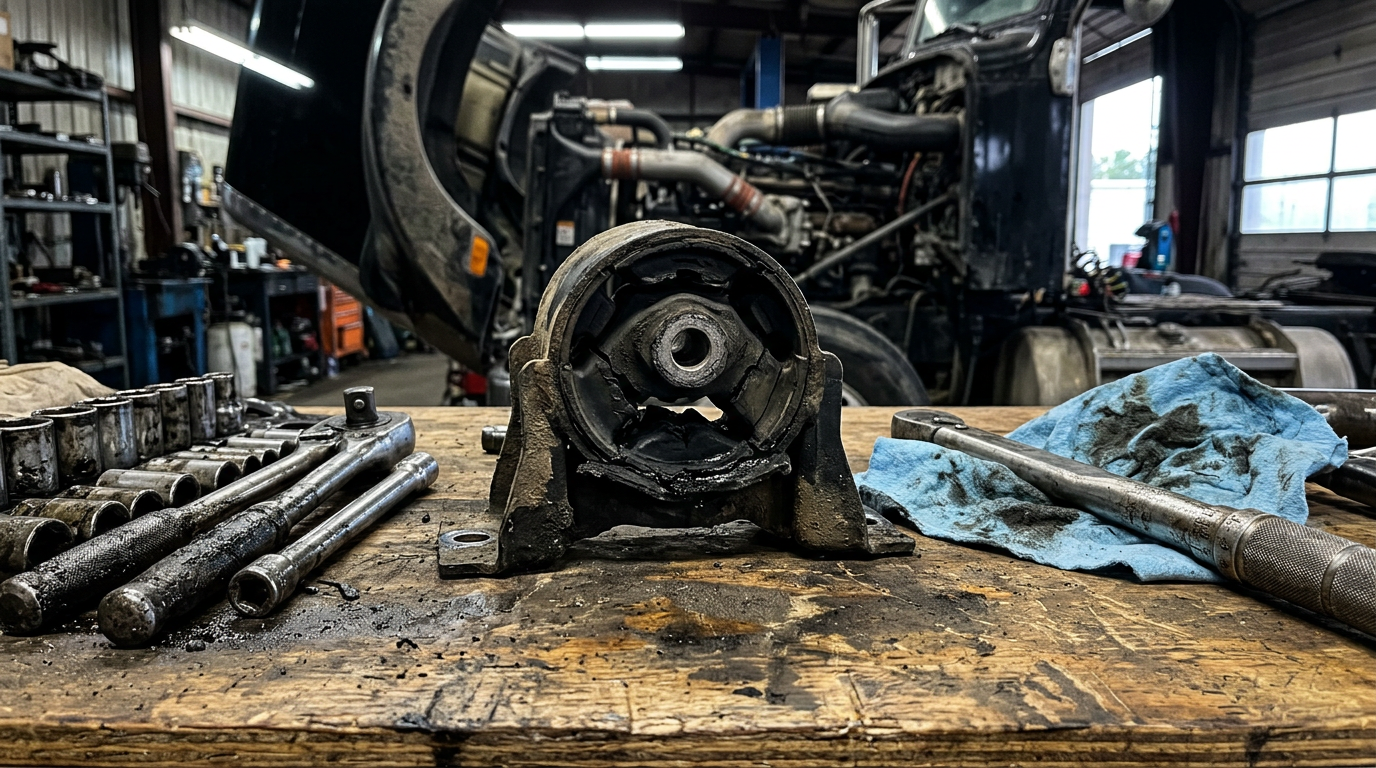
You feel it before you ever see it. A shudder through the seat at idle that wasn't there last month. A clunk when you drop the hammer from a stop. Maybe the hood lines up different than it used to. That's usually not the engine talking — it's the engine mounts (and sometimes the transmission mount) giving up the fight against thousands of pounds of torque and vibration, day after day.
Mounts are cheap, rubber-and-steel parts that everybody ignores until they fail — and then they take other stuff down with them. A collapsed mount lets the powertrain shift under load, which chews up exhaust flex sections, radiator hoses, fan shrouds, and even wiring harnesses that were never designed to flex like that.
On trucks like the Peterbilt 337, which spend their life in vocational duty with a lot of stop-and-go, PTO use, and off-road jostling, mounts wear faster than you'd think. This guide covers what to look for, how to check it yourself, and when it's time to swap them out before they take your driveline with them.
What Engine & Transmission Mounts Actually Do
The engine mount and transmission mount aren't just there to hold the powertrain in place — they isolate vibration and absorb torque reaction as the engine twists under load every time you accelerate. Most are rubber bonded to steel brackets, though some heavy-duty applications use polyurethane or hydraulic designs for better load control.
On a mid-duty chassis like the Peterbilt 337, you're typically looking at a front mount pair on the engine block and a rear mount at the transmission tailhousing or crossmember, depending on the drivetrain configuration. These parts see heat, oil contamination, and constant flex cycles — that rubber doesn't last forever.
When a mount is healthy, the engine barely moves under acceleration or braking. When it's failing, you get excess movement that translates straight into the cab, the exhaust system, and anything bolted near the powertrain. Think of mounts as the shock absorbers for your drivetrain's torque, not just a bracket holding things down.
Common Symptoms of a Failing Mount
Mount failure rarely announces itself with a warning light — you've got to catch it by feel and sound. Here's what to watch for:
- Vibration at idle that smooths out or changes character once you're rolling
- Clunk or thud on hard acceleration, deceleration, or shifting gears
- Visible engine sag or lean when you pop the hood, especially compared to the transmission or frame rails
- Exhaust rattle or contact noise where the pipe runs close to the frame or crossmember
- Belt or fan noise that comes and goes with RPM, caused by the engine shifting relative to the fan shroud
- Cracked or oil-soaked rubber visible on inspection
If you're chasing a vibration that mechanics keep blaming on the drive shaft or u-joints and those check out fine, don't overlook the mounts. A lot of drivetrain vibration complaints trace straight back to a collapsed or torn mount that nobody bothered to look at closely.
How to Inspect Mounts for Sag & Damage
You don't need a lift to catch most mount failures — just eyes, hands, and a pry bar.
- Pop the hood and look at the gap between the engine block and the frame rail on both sides — uneven gaps mean sag
- Check the rubber for visible cracking, tearing, or separation from the metal plates
- Look for oil or fuel contamination on the rubber — it breaks down the compound fast
- With the engine off, have someone rock the fan belt or accessory bracket while you watch for excess movement at the mount
- Use a pry bar (carefully) to apply light leverage at the mount and check for play between the bracket and the block or frame
- Check mounting bolts for looseness — torque per OEM spec if anything's backed off
On a Peterbilt 337, also check the transmission mount at the crossmember — it's often the first one to go given the tailshaft angle and PTO loading common on vocational builds.
When to Replace vs. When to Leave It
Not every worn mount needs replacing today, but don't stretch it too far. Replace it when:
- The rubber is visibly cracked, torn, or separating from metal
- You can see or measure sag beyond OEM tolerance
- There's metal-to-metal contact or the bracket has bent
- Vibration or clunk symptoms are present and other drivetrain components check out fine
Mounts are usually sold and replaced in matched sets for a reason — if one side's shot, the other's not far behind, and mixing an old worn mount with a new one just puts uneven load back on the new part. Always torque mounting bolts to OEM spec — overtightening can crush the rubber isolator and undertightening lets it walk.
If mount failure has caused the powertrain to shift enough to affect steering linkage clearance, brake lines, or exhaust routing near fuel lines, that's not a DIY call anymore — get a certified tech to inspect and sign off before the truck goes back in service.
What Happens If You Ignore It
A bad mount doesn't stay a $200-300 problem for long. Once the engine or transmission starts moving around under load, it puts stress on everything connected to it:
- Exhaust flex pipes and clamps crack from repeated flexing
- Radiator hoses and fan shrouds get chafed or punctured
- Wiring harnesses near the block or transmission fray and short
- Drivetrain alignment drifts, accelerating u-joint and driveshaft wear
- Clutch or torque converter wear increases from misalignment between engine and transmission centerlines
On vocational trucks like the Peterbilt 337 running PTO equipment, a shifted engine can also throw off PTO shaft alignment, leading to premature failure there too. What starts as an annoying vibration can turn into a driveline alignment job or a cracked exhaust manifold if you let it ride too long. Mounts are cheap insurance — treat them that way.
Quick answers
Why does my truck shake at idle but smooth out once I'm rolling?
That's a classic sign of a worn engine mount — at idle the engine has more freedom to rock on a soft or torn mount, and once RPMs climb the vibration frequency shifts out of the range you feel. Check the mounts before you chase anything in the fuel or ignition system.
Can a bad engine mount cause transmission problems?
Yes — a failed mount lets the engine and transmission shift out of alignment, which can throw off input shaft angle, wear the clutch or torque converter unevenly, and stress the driveshaft and u-joints. It's often mistaken for a transmission problem when the real cause is upstream.
Is it safe to keep driving with a broken engine mount?
Short trips at low load are lower risk, but a broken mount lets the powertrain shift enough to damage exhaust, wiring, and driveline components fast. If you feel a clunk or see visible sag, get it inspected and replaced before it does more damage.
How do I tell if it's the engine mount or the transmission mount?
Watch where the vibration or clunk is loudest — front-of-cab noise tied to acceleration often points to the engine mount, while a thud on gear changes or deceleration usually points to the transmission mount. A visual check under the hood with the engine off will usually confirm which one's sagging.
How often should engine mounts be replaced on a fleet truck?
There's no fixed mileage interval — it depends on duty cycle, but vocational trucks with heavy PTO use or rough terrain wear mounts faster than highway tractors. Inspect mounts at every major PM and replace per OEM spec any time you see cracking, sag, or oil contamination on the rubber.
Parts for this job
Real products from the PartsNow catalog. Confirm fitment with Mike before ordering.


Still not sure what's wrong?
Mike — the free AI truck consultant — will walk through your exact symptoms and point you to the right part. No account, English or Spanish, 24/7.
Related truck: Peterbilt 337— specs & parts
