Turbocharger Failure Symptoms: Boost Leaks, Whine & Diagnosis
July 18, 2026 · PartsNow Guides
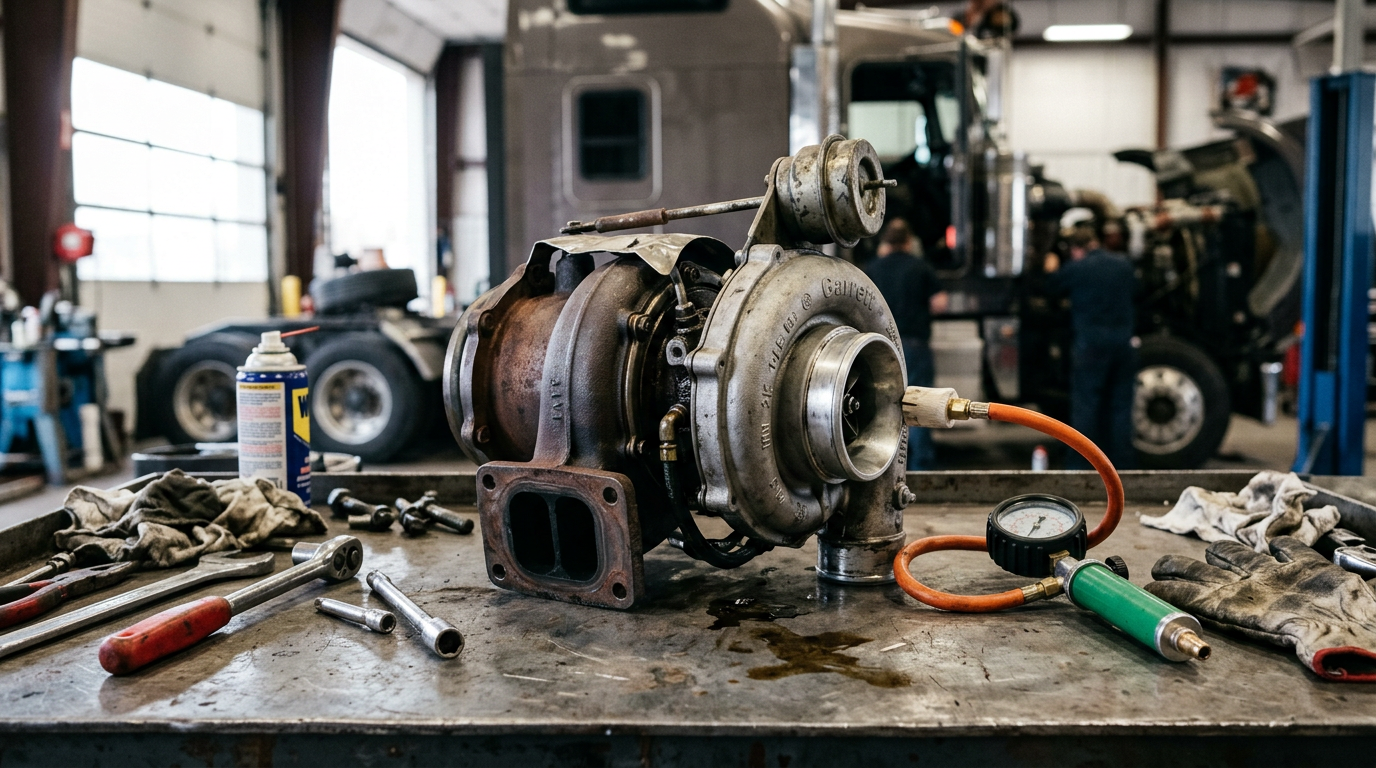
That high-pitched whine under acceleration isn't your imagination, and neither is the way your truck's lost some pull going up the grade it used to climb without a downshift. Turbos don't usually die all at once—they give you warning signs for weeks, sometimes months, before they let go completely. The trouble is most drivers write off the early symptoms as "just getting old" until they're stuck on the shoulder with metal shavings in the intake.
A turbo failure caught early is a boost leak repair or a $couple-hundred rebuild kit. A turbo failure ignored is a bent valve, scored cylinder walls, or a compressor wheel that ate itself and sent debris straight into your engine. This guide walks through what to listen for, what to look for, and how to tell the difference between a nuisance leak and a turbo that's about to leave you stranded.
We'll cover the diagnostic steps any competent shop should run before quoting you a repair—because "just replace the turbo" is sometimes the wrong answer, and sometimes it's the only answer.
The Whine, Whistle, and Other Sounds That Mean Trouble
A healthy turbocharger makes a smooth spooling sound under load. When that sound changes character, pay attention.
- High-pitched whine that gets worse under boost — often a failing bearing or worn shaft seal letting the wheel run out of true
- Whistling that changes with engine RPM but not load — usually points to a boost leak, not the turbo itself
- Grinding or metallic rattle — stop driving. This is bearing failure or wheel-to-housing contact, and continuing to run it risks total turbo destruction and debris ingestion downstream
- Chirping on deceleration — can be a loose compressor wheel or shaft play
Don't assume every noise is the turbo. Boost leaks at clamps, cracked intercooler piping, and even a loose air filter housing can mimic turbo whine. Before you condemn the unit, do a proper leak test — covered below.
Smoke Signals: Blue, Black, and What They're Telling You
Exhaust smoke color is one of the fastest diagnostic tools you have, and it's free.
Blue-gray smoke at idle or on acceleration usually means oil is getting past the turbo's seals into the intake or exhaust side. This is a classic sign of worn turbo bearings or shaft seals letting oil bypass into the compressor housing. If you're topping off oil more often than usual with no visible leaks underneath the truck, the turbo is likely burning it.
Black smoke under load typically means the engine isn't getting enough boost — you're running rich because the ECU is calling for fuel based on expected airflow that isn't showing up. This points to a boost leak, a failing wastegate, or a turbo that's lost efficiency (worn wheels, fouled internals).
White smoke is usually coolant, not turbo-related, but don't rule out a cracked turbo housing on liquid-cooled units.
Document when the smoke happens — cold start, under load, at idle — because that timing narrows down the cause fast.
Oil in the Intake and Low Power: Confirming the Diagnosis
Pull the intake tubing between the turbo and intercooler. Oil residue or pooling here confirms the turbo is pushing oil past its seals — no guesswork needed.
Low power complaints deserve a systematic check before you blame the turbo:
- Check air filter restriction — a clogged filter starves the turbo of air
- Inspect for exhaust restrictions (collapsed flex pipe, clogged DPF) that choke turbo spin-up
- Verify boost pressure against OEM spec using a hand-held gauge at idle and under load
- Check for excessive shaft play by hand — grab the compressor wheel through the intake opening and wiggle. Any noticeable side-to-side or in-out movement beyond a slight amount means bearing wear
If boost is consistently low, air filter's clean, and exhaust flows freely, the turbo itself — or a leak in the system feeding it — is your prime suspect. That's where a proper boost leak test earns its keep.
Boost Leak Testing and Wastegate Checks
A boost leak test is cheap insurance before you condemn a turbo.
To test for boost leaks:
- Disconnect the charge pipe at the intake manifold and cap it off, or use a dedicated boost leak tester
- Pressurize the system to a set PSI (per manufacturer test procedure) using shop air
- Listen and feel along every clamp, coupler, and intercooler seam for escaping air
- Check the charge air cooler itself for pinhole leaks or cracked end tanks
A system that won't hold pressure means you've found your low-power culprit — and it might have nothing to do with the turbo.
Wastegate checks:
- Inspect the actuator rod for freedom of movement — it should move smoothly when you push it by hand with the engine off
- Look for a stuck-open wastegate (causes low boost, black smoke) or stuck-closed (causes overboost, potential overspeed damage)
- Check actuator linkage for corrosion or looseness
A stuck wastegate is often a repair, not a full turbo replacement — worth ruling out before you spend big money.
Rebuild vs. Replace: Making the Call
Once you've confirmed it's the turbo and not a leak or wastegate issue, you've got a decision to make.
Rebuild makes sense when:
- The core housing and compressor/turbine wheels are undamaged
- Failure was caught early — no debris ingestion into the engine
- You've got a reputable rebuilder with a warranty on the kit
Replace makes sense when:
- There's visible wheel damage, housing cracks, or shaft galling
- The unit ingested debris and may have sent metal into the intake or exhaust
- Downtime cost outweighs the savings — a new or remanufactured unit gets you rolling faster with less risk
Either way, always replace the oil feed line and check the return line for restrictions before installing a rebuilt or new turbo. Feeding a fresh turbo old, sludged oil or a partially clogged return is the #1 cause of repeat failures. Flush the intercooler and piping too — leftover oil and debris will kill the new unit just as fast as the old one died.
Quick answers
Can I keep driving with a whining turbo?
Short term, maybe — but you're gambling. If the whine is from bearing wear, the shaft can seize or the wheel can contact the housing without warning, sending metal debris into your engine. Get it diagnosed before your next long haul, not after.
How much oil consumption is normal with a bad turbo?
There's no universal number since it depends on engine size and severity, but any noticeable increase in oil top-offs with blue smoke present usually means the turbo seals are failing. Track your oil usage over a few hundred miles to confirm the trend before assuming it's the turbo.
Will a boost leak throw a check engine light?
Often yes — most modern diesels will trigger a low boost or boost pressure deviation code, but small leaks can sometimes stay under the radar depending on your ECU's tolerances. Don't rely on the dash light alone; do a physical boost leak test if you notice power loss or smoke.
Parts for this job
Real products from the PartsNow catalog. Confirm fitment with Mike before ordering.


Still not sure what's wrong?
Mike — the free AI truck consultant — will walk through your exact symptoms and point you to the right part. No account, English or Spanish, 24/7.
