Cascadia Coolant Leaks: Finding the Source Before Overheat
July 24, 2026 · PartsNow Guides
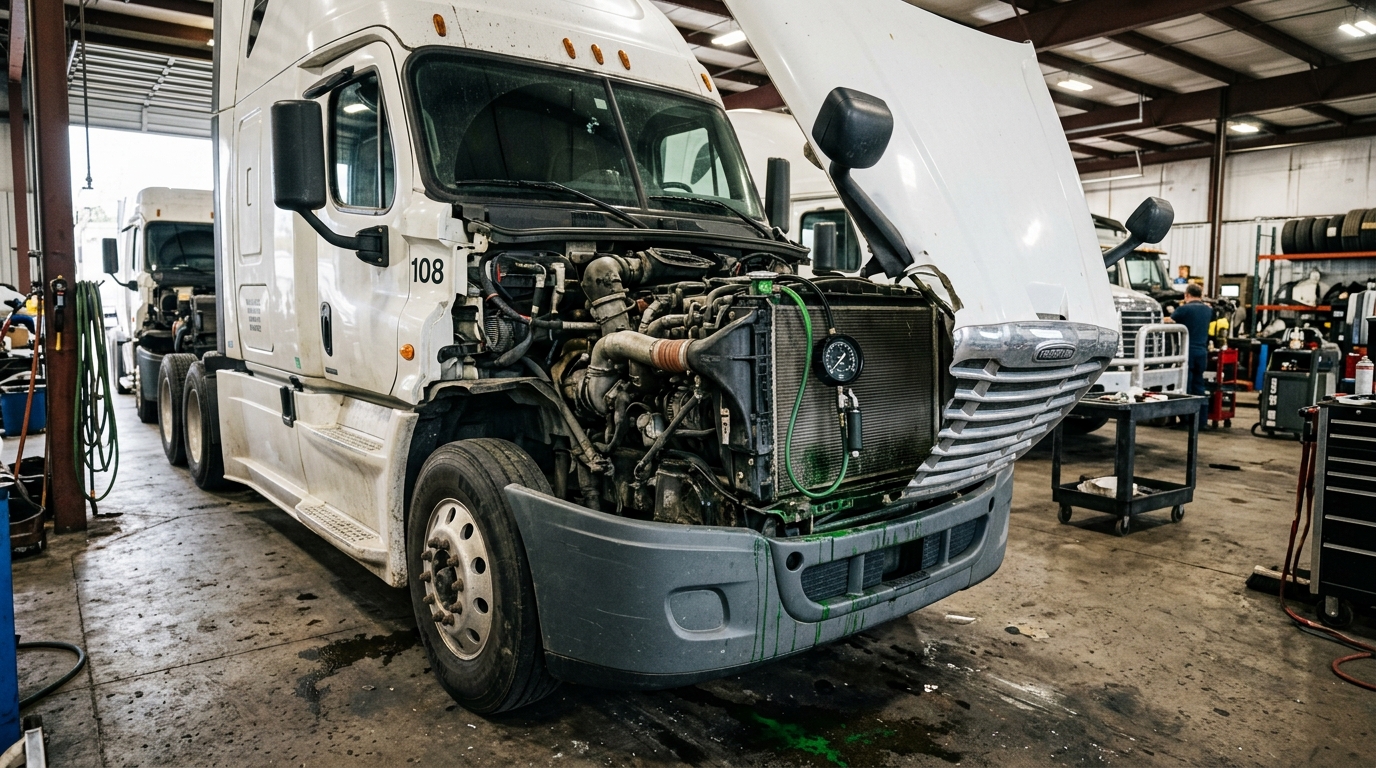
You top off the coolant Monday, and by Thursday the reservoir's low again. No puddle under the truck, no warning light yet — just coolant disappearing into thin air. That's the leak that gets guys in trouble, because by the time the temp gauge climbs on the interstate, you're already looking at a possible head gasket or worse.
Cascadias have a handful of known weak spots for coolant loss: the water pump seal, EGR cooler, surge tank, and the maze of hose connections around the front of the engine. Some leaks are obvious drips. Others only show up under pressure, or burn off before you ever see a stain on the ground.
The fix isn't guessing and replacing parts one at a time until something works. It's a systematic pressure test and dye check that shows you exactly where the coolant's going — before it costs you a tow and an engine.
Know the Usual Suspects on a Cascadia
Before you start tearing into anything, know where Cascadias typically leak.
- Water pump seal - weeps coolant down the front of the block, often shows as a stain or crust below the pump
- EGR cooler - internal or external leaks; internal ones show up as coolant loss with no visible puddle, sometimes white exhaust smoke
- Surge tank (coolant reservoir) - plastic cracks from age and heat cycling, especially around the cap and mounting bosses
- Hose connections - clamps loosen or hoses crack at the heater core lines, turbo coolant lines, and the connections near the EGR
- Radiator seams and end tanks - less common but worth checking on higher-mileage trucks
If you're chasing a slow leak with no visible drip, put the EGR cooler and water pump seal at the top of your list. Those two account for a big share of the "mystery" coolant loss calls.
Do a Visual Inspection First
Don't skip the cheap step. A good visual can save you an hour of pressure testing.
- Wipe down the engine and let it sit overnight, then inspect for fresh wet spots or dried coolant crust (it's often crusty and slightly colored, not just wet)
- Check under the truck for stains on the frame rail or DPF/EGR area
- Look at hose clamps for looseness, rust streaks, or cracked rubber at the clamp line
- Inspect the surge tank for hairline cracks, especially near the cap threads and mounting tabs
- Check the water pump weep hole area at the bottom of the pump housing for green or orange residue
If you find obvious damage — a split hose, a cracked tank — you're done diagnosing. If everything looks clean but you're still losing coolant, move to pressure testing.
Pressure Test the Cooling System
A cooling system pressure tester is the single best tool for this job, and most shops have one.
- Let the engine cool completely before opening the system — hot coolant under pressure will burn you
- Remove the surge tank cap and attach the pressure tester adapter
- Pump the system up to the cap's rated pressure per OEM spec — don't exceed it, you can blow a weak hose or crack the tank further
- Hold pressure and watch the gauge; if it drops steadily, you've got an active leak somewhere in the system
- With pressure held, walk the engine and look/listen for hissing, dripping, or wet spots you missed on the visual check
- Pay close attention to the water pump, EGR cooler lines, and every hose connection while pressure is applied
If the gauge holds steady but you're still losing coolant over time, the leak is likely internal — think EGR cooler or a head gasket — and needs further testing.
Dye-Check for Leaks You Can't See
When a leak is small, intermittent, or internal, fluorescent dye is what finds it.
- Add UV-reactive coolant dye to the system per the dye kit's instructions — don't overdo it, a little goes a long way
- Run the engine to full operating temperature and let the system pressurize normally
- Shut down, let it cool enough to safely inspect, then use a UV light to scan the water pump, EGR cooler, hose connections, and surge tank
- Dye will show as a bright yellow-green glow at the exact leak point, even from a leak too slow to see with the naked eye
- For suspected EGR cooler leaks, check the coolant recovery tank and look for dye in the exhaust condensate or oil — a sign of internal EGR cooler failure
This method is especially useful for catching weeping water pump seals early, before they fail completely on the road.
When It's an Internal Leak, Not External
If pressure testing and dye checks come up clean outside the engine but coolant keeps disappearing, you're likely dealing with an internal leak — coolant getting into the oil or combustion chamber.
Signs to watch for:
- Milky or foamy coolant-contaminated oil on the dipstick
- White smoke from the exhaust, especially on startup
- Coolant loss with no exterior stains anywhere
- Rough idle or combustion issues that seem unrelated to coolant
This points to a failed EGR cooler internally, a bad head gasket, or in rarer cases a cracked head or liner seal. These aren't shade-tree fixes — they require a compression test, oil analysis, and likely engine teardown to confirm. Get a certified diesel tech involved before you keep driving the truck, because running it low on coolant with an internal leak is how you turn a repair bill into an engine replacement.
Quick answers
How much coolant loss on a Cascadia is normal before I should worry?
Any coolant loss that isn't accounted for by a known top-off or maintenance event should get checked out. If you're adding coolant more than once every few weeks with no visible leak, treat it as a real problem and start diagnosing rather than just topping off.
Can I just keep adding coolant until I get to a shop?
For a short trip to get the truck looked at, topping off is fine as long as the temp gauge stays normal. But if you're losing coolant fast or the temp starts climbing, pull over and get it inspected — running low on coolant risks overheating and serious engine damage.
Is a weeping water pump on a Cascadia something I can keep driving on?
A slow weep might get you through a few more loads, but water pump seals don't get better on their own — they fail completely eventually, often without much warning. Since a failed pump can leave you stranded or overheat the engine, get it replaced on a schedule rather than waiting for it to quit on the highway.
Parts for this job
Real products from the PartsNow catalog. Confirm fitment with Mike before ordering.

4083
4083 - COOLANT FILTER
$0.00

DBC4086
DBC4086 - COOLANT FILTER, SPIN-ON DONALDSON BLUE NO CHEMICAL (P554086-100-140)
$30.78

DBC4785
DBC4785 - COOLANT FILTER, SPIN-ON DONALDSON BLUE NO CHEMICAL (P554785-100-541)
$69.26

15W40 OIL
15W40 OIL - 15W40 OIL (ROTELLA) GAL JUG
$25.00

FS19765FLG
FS19765FLG - FUEL FILTER SEPARATOR
$32.95

243009
243009 - AIR COMPRESSOR FILTER
$20.63

RADHOSE_2-1/2
RADHOSE_2-1/2 - 2-1/2' RADIATOR HOSE, PER FT
$24.00
Still not sure what's wrong?
Mike — the free AI truck consultant — will walk through your exact symptoms and point you to the right part. No account, English or Spanish, 24/7.
Related truck: Freightliner Cascadia— specs & parts
